From Generators to CNC Machines: Everything You Can Rent in Rentam’s Industrial Equipment Category
Running a manufacturing operation, a processing plant, a warehouse, or an engineering workshop in Nigeria means confronting a category of cost that few other business decisions rival — the cost of industrial machinery.
A food processing startup in Lagos knows it needs an industrial mixer, a packaging line, and cold storage to move from small-batch production to real commercial volume, but the ₦8 million to ₦15 million required to acquire that equipment outright would consume every naira of investment the business has raised before a single unit reaches the market. A metal fabrication workshop in Nnewi wins a contract requiring CNC machining capacity it does not currently have, and the machine that would fulfill that contract costs more than the contract itself is worth. A logistics company in Apapa experiencing a seasonal surge in warehouse throughput needs additional forklifts and conveyor capacity for three months, but buying that equipment for a seasonal spike means it sits idle, depreciating, for the other nine months of the year.
The economics of industrial equipment ownership are unforgiving in a way that few other business expenses are. A generator large enough to power a small factory costs millions of naira and still needs regular servicing, spare parts, and eventual overhaul. An air compressor, essential to pneumatic tools and processing lines across dozens of industries, represents both a significant purchase price and an ongoing maintenance obligation. A hydraulic press, a CNC lathe, a bottling line — each one is not simply bought once and forgotten, but bought, insured, housed, maintained, serviced, and eventually replaced as technology moves forward and the machine’s resale value collapses. For a Nigerian SME or industrial entrepreneur operating on tight margins, this compounding cost structure — purchase price, storage space, maintenance budget, technology obsolescence — can consume capital that should be going into growth, hiring, and production itself.
Compounding the problem is the reality that much of Nigeria’s industrial demand is not continuous. A factory expanding production for a specific bulk order needs additional machine capacity only for the duration of that order. An engineering firm bidding on a project requiring specialized fabrication equipment needs that equipment only for the project’s timeline. A cold storage facility experiencing a harvest-season surge in perishable goods needs additional refrigeration capacity only during that surge. A construction-adjacent manufacturer needs a generator during a power-intensive production run and has no ongoing need for that generator’s full capacity the rest of the year. Buying industrial equipment for needs like these means committing permanent capital to temporary demand — one of the least efficient decisions any industrial business can make.
The traditional Nigerian response to this mismatch has been informal machinery hire — calling around an industrial estate to find someone with a spare generator, negotiating verbally with an equipment owner with no documentation of condition or liability, and hoping the machine that arrives actually performs as promised, with no recourse if it does not. For industrial operations, where equipment failure does not just cause inconvenience but can halt an entire production line, damage raw materials, or delay a client order with real financial penalties attached, this level of uncertainty is a serious business risk, not a minor inconvenience.
What Nigerian industry has needed is a structured, verified, and transparent way to access industrial machinery precisely when production, processing, or project demand calls for it — without the capital burden, the maintenance obligation, the storage requirement, and the depreciation risk of outright ownership. Rentam Rental Services was built to provide exactly that. Through the Industrial Equipment category on our platform, we have created a marketplace where manufacturers, factories, processing plants, warehouses, logistics operators, engineering firms, contractors, SMEs, and industrial entrepreneurs across Nigeria can access the machinery their operations need, for exactly the duration that need exists, with the verification, transparency, and accountability that industrial-scale work demands.
This guide covers everything you need to know about Rentam’s Industrial Equipment category. We explain what industrial equipment is, describe each major equipment type available on the platform, tell you who each type serves, and walk you through how to rent with confidence. Whether you run a factory floor, a processing plant, a warehouse, or an engineering workshop, this guide is written for you.
What Is Industrial Equipment?
Industrial equipment refers to the machinery and mechanical systems used in manufacturing, production, fabrication, processing, warehousing, packaging, material handling, and power generation — the equipment that transforms raw materials into finished products, moves goods efficiently through supply chains, and keeps industrial operations powered and running. This is distinct from Rentam’s Construction Equipment category, which focuses on machinery for building and civil works, and from our Building Tools and Professional Tools categories, which cover smaller hand-operated and portable equipment. Industrial Equipment is defined by its role in production and processing environments — factory floors, workshops, processing plants, and warehouses rather than construction sites.
In everyday Nigerian industrial contexts, this is the machinery you find inside factories and processing facilities — the generators powering entire production lines, the air compressors driving pneumatic tools and processing equipment, the CNC machines and lathes shaping metal components with precision, the industrial mixers blending raw materials at scale, the forklifts and conveyor systems moving goods through warehouses, the packaging and bottling equipment preparing products for market, and the cold storage systems preserving perishable goods.
Industrial equipment is not reserved for large manufacturing conglomerates. A small food processing business in Ibadan needs an industrial mixer and packaging equipment to scale beyond manual production. A metal workshop in Aba needs welding machines and a lathe for fabrication contracts. A logistics operator in Kano needs forklifts and pallet jacks for warehouse throughput during peak periods. All of these users, across every scale of industrial operation, are what Rentam’s Industrial Equipment category was built to serve.
What Is the Industrial Equipment Category on Rentam?
Rentam organises its listings into focused categories so that industrial operators can find exactly the machinery their production or processing need demands, without sorting through irrelevant listings. The Industrial Equipment category is one of our most technically demanding sections, given that much of this machinery requires specific technical knowledge, careful handling, and in many cases, trained operators.
Think of Rentam’s Industrial Equipment section as a structured machinery yard — one that exists on your phone or computer, is accessible from anywhere in Nigeria, and connects you only to verified, documented rental arrangements. Unlike sourcing machinery through informal industrial estate networks with no verification of condition, capacity, or maintenance history, renting through Rentam means you know precisely what equipment you are getting, its specifications and capacity, what it costs, whether an operator is included, how long you can have it, and what recourse exists if the equipment does not perform as described.
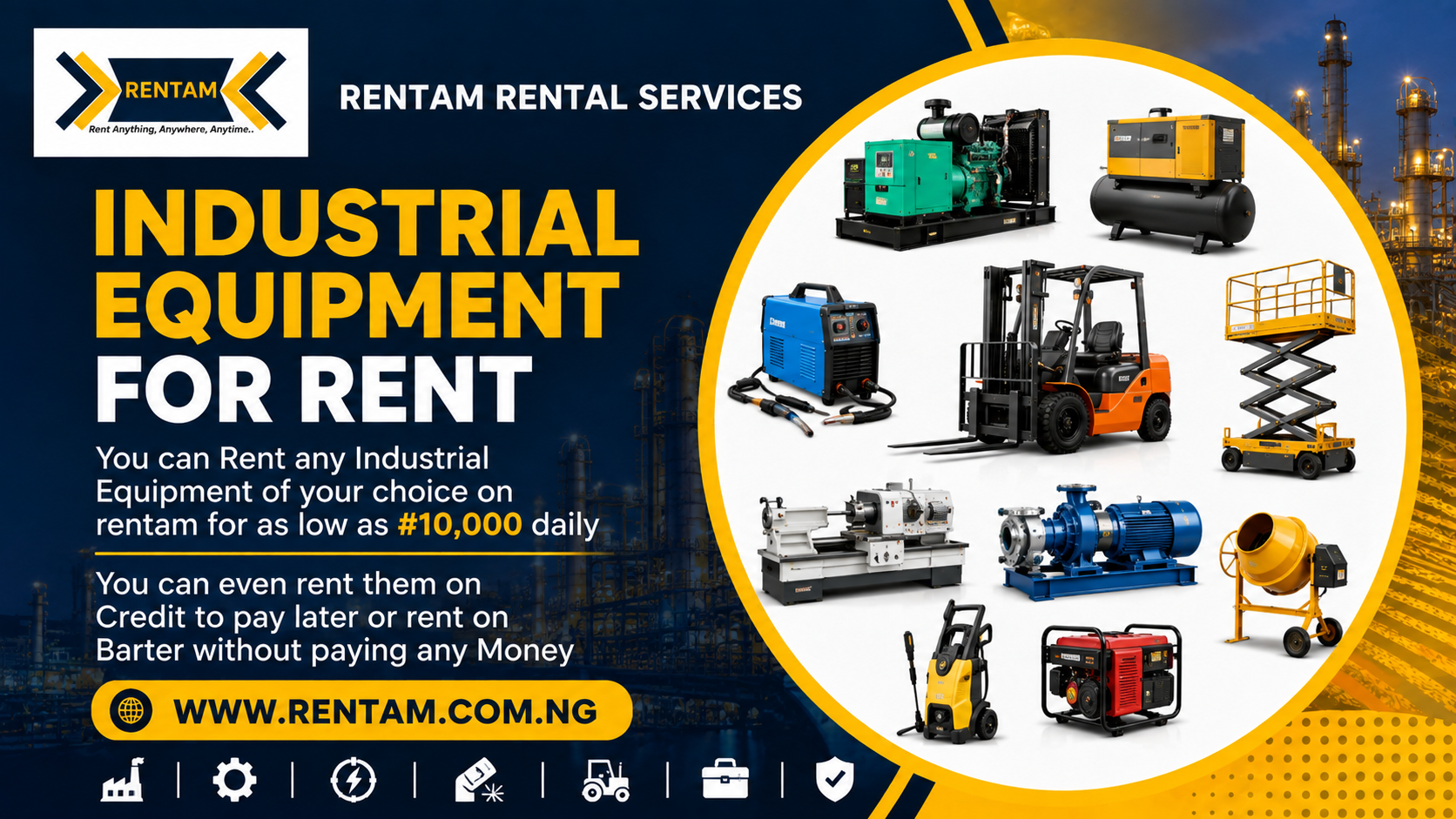
The category covers power generation equipment including generators and power distribution systems, compressed air systems including industrial air compressors, industrial pumps for fluid and material transfer, machining equipment including CNC machines, lathes, milling machines, and drilling machines, fabrication equipment including welding machines and hydraulic presses, production equipment including industrial mixers and industrial ovens, material handling equipment including forklifts, pallet jacks, cranes, hoists, and conveyor systems, packaging and processing equipment including packaging machines, shrink wrappers, bottling equipment, and food processing machinery, cold storage and refrigeration equipment, boilers and water treatment systems, and dust collection, ventilation, and industrial fan systems. Each of these has its own listing standards, rental duration structures, and relevant user groups — and we will walk through them all in this guide.
Generators and Power Distribution Equipment
No discussion of Nigerian industry can begin anywhere other than power. National grid electricity remains too unreliable for continuous industrial production, and every factory, processing plant, and workshop in Nigeria depends on generators to keep operations running. Industrial-capacity generators — sized to power entire production lines rather than a household or small office — cost between ₦3 million and ₦20 million or more depending on capacity, and beyond the purchase price, they require regular servicing, fuel system maintenance, and periodic overhaul to remain reliable.
For a business scaling production temporarily for a bulk order, or a processing plant needing backup capacity during a specific period of grid instability, buying an industrial generator outright represents a massive capital commitment for what may be a defined, temporary need. Rentam lists industrial generators for rental, including mid-range generators from 50 KVA to 150 KVA for small and medium manufacturing operations, high-capacity generators above 150 KVA for larger factories and processing plants, and power distribution equipment including transfer switches and distribution panels for managing industrial power supply.
A food processing business in Lagos taking on a large bulk order requiring extended production hours can rent a high-capacity generator for the order’s fulfillment period, maintain uninterrupted power for the production run, and return the generator once the order ships, rather than committing millions of naira to permanent generator capacity used intensively only occasionally. A factory in Ogun State experiencing extended grid outages during a specific season can rent additional generator capacity as backup, protect production continuity, and return the equipment once grid reliability improves. Generators keep Nigerian industry running. Rentam makes that power accessible without the full weight of ownership.
Air Compressors — Powering Pneumatic Tools and Processes
Compressed air drives an enormous range of industrial processes and tools — pneumatic tools, spray painting systems, packaging machinery, and various manufacturing processes across sectors from automotive workshops to food processing. Industrial air compressors cost between ₦300,000 and ₦3 million depending on capacity and type, and like most industrial equipment, their use is often tied to specific production runs or projects rather than continuous daily operation.
Rentam lists air compressors for rental, including portable air compressors for smaller workshops and mobile applications, and stationary industrial compressors for continuous production-line use in factories and processing plants.
A vehicle workshop in Warri taking on a bulk fleet servicing contract requiring extensive pneumatic tool use can rent an additional air compressor for the contract duration, meet the increased workload, and return the equipment once the contract is complete. A manufacturing operation in Kaduna running a temporary second production shift can rent supplementary compressed air capacity for that period specifically, rather than investing in permanent capacity exceeding normal operational needs. Air compressors power countless industrial processes. Rentam makes that power available exactly when demand requires it.
Industrial Pumps — Moving Fluids and Materials at Scale
Industrial pumps move water, chemicals, slurries, and other fluids and semi-fluid materials through production processes, water treatment systems, and site drainage or supply networks. Centrifugal pumps, submersible pumps, and specialized chemical transfer pumps each serve different industrial applications, and pump costs range from ₦150,000 for smaller units to over ₦2 million for high-capacity industrial pumps.
Rentam lists industrial pumps for rental, including centrifugal pumps for general fluid transfer applications, submersible pumps for dewatering and below-ground fluid handling, and specialized transfer pumps for chemical and process fluid applications.
A processing plant in Rivers State needing additional water transfer capacity during a production expansion can rent industrial pumps for the expansion period, maintain process continuity, and return the equipment once normal capacity resumes. A facility managing a temporary flooding or dewatering situation can rent submersible pumps for the specific duration required, resolve the issue, and avoid the cost of owning pumps needed only occasionally. Industrial pumps keep fluids and materials moving through production processes. Rentam makes that capacity available on demand.
CNC Machines, Lathes, Milling Machines, and Drilling Machines
Precision machining — cutting, shaping, and drilling metal and other materials to exact specifications — is central to manufacturing, fabrication, and engineering work across Nigeria. CNC (Computer Numerical Control) machines automate precision cutting and shaping with a level of accuracy manual methods cannot match, while lathes, milling machines, and drilling machines handle a range of shaping and boring tasks. This machinery represents some of the highest capital investment in the industrial equipment category — a CNC machine alone can cost anywhere from ₦2 million to over ₦20 million depending on capability.
Rentam lists CNC machines for precision manufacturing and fabrication work, lathes for turning and shaping cylindrical metal components, milling machines for cutting and shaping flat and contoured surfaces, and drilling machines for precision boring across various materials.
An engineering workshop in Nnewi winning a fabrication contract requiring CNC precision beyond its current capacity can rent a CNC machine for the contract’s duration, fulfill the specification requirements professionally, and return the equipment once the contract is delivered, rather than investing in machinery that may not see continuous future use. A small fabrication business in Aba can rent a lathe for a specific batch of components requiring turning work, complete the job efficiently, and avoid the substantial cost of owning precision machining equipment used only intermittently. Machining equipment enables precision manufacturing. Rentam makes that precision accessible without the full capital burden of ownership.
Welding Machines and Hydraulic Presses — Fabrication and Forming Equipment
Welding machines join metal components, while hydraulic presses form, bend, and shape metal under controlled pressure — both essential to fabrication work across construction-adjacent manufacturing, automotive repair, and general metalworking. Industrial welding machines cost between ₦150,000 and ₦800,000 depending on type and capacity, while hydraulic presses range from ₦500,000 to several million naira depending on tonnage and application.
Rentam lists welding machines including MIG, TIG, and arc welding equipment for different fabrication applications, and hydraulic presses for metal forming, bending, and pressing operations.
A fabrication workshop in Onitsha taking on a large gate and railing production contract can rent additional welding machines for the contract period, expand production capacity temporarily, and return the equipment once the order is fulfilled. A small manufacturing business in Lagos requiring hydraulic pressing for a specific production run can rent a press for that run’s duration, complete the forming work required, and avoid the cost of owning specialized pressing equipment used only occasionally. Welding and pressing equipment enables fabrication work at scale. Rentam makes that capacity available precisely when contracts demand it.
Industrial Mixers and Industrial Ovens — Production and Processing Equipment
Industrial mixers blend raw materials — ingredients, chemicals, or compounds — at volumes far beyond what manual mixing can achieve, essential for food processing, chemical production, and manufacturing across many sectors. Industrial ovens provide controlled heating for baking, curing, drying, and thermal processing. Both represent significant investment — industrial mixers cost between ₦400,000 and ₦3 million, and industrial ovens follow a similar range depending on capacity and specialization.
Rentam lists industrial mixers for food production, chemical blending, and manufacturing applications, and industrial ovens for baking, curing, and thermal processing needs.
A bakery in Abuja scaling up for a large bulk order beyond its normal daily capacity can rent an additional industrial oven for the order’s production period, meet the increased demand, and return the equipment once the order is complete. A small-scale food processing business in Ibadan expanding into a new product line can rent an industrial mixer to test production at scale before committing to permanent equipment, validate the product and process, and then decide on purchase based on confirmed demand. Mixers and ovens turn raw inputs into finished products at industrial scale. Rentam makes that scale accessible without permanent capital commitment.
Forklifts, Pallet Jacks, and Material Handling Equipment
Moving goods efficiently through warehouses, factories, and distribution centers is central to industrial and logistics operations. Forklifts move heavy pallets and materials across warehouse floors, pallet jacks handle lighter, more localized movement, and broader material handling equipment supports the flow of goods through production and storage facilities. A forklift costs between ₦2 million and ₦8 million depending on capacity and type, a significant investment for operations whose material handling needs fluctuate seasonally or with specific projects.
Rentam lists forklifts in various lifting capacities for warehouse and factory material movement, pallet jacks for manual and powered load handling, and broader material handling equipment including hand trucks and platform trolleys.
A warehouse in Apapa experiencing a seasonal surge in inbound and outbound shipment volume can rent additional forklifts for the surge period specifically, maintain efficient throughput during peak demand, and return the equipment once volumes normalize, rather than owning forklift capacity that sits underutilized most of the year. A manufacturing facility in Ogun State relocating production equipment during a facility expansion can rent forklifts for the relocation period, move heavy machinery safely and efficiently, and return the equipment once the move is complete. Material handling equipment keeps goods moving efficiently. Rentam makes that capacity available exactly when volume demands it.
Cranes and Hoists — Industrial Lifting Solutions
Beyond warehouse-floor material handling, many industrial operations require lifting capacity for heavier loads — positioning heavy machinery, lifting materials to elevated storage or production levels, or handling loads beyond what forklifts can manage. Overhead cranes, mobile industrial cranes, and hoists serve these needs, and this equipment represents some of the highest-value machinery in industrial operations, often costing millions of naira.
Rentam lists mobile industrial cranes for machinery positioning and heavy lifting tasks, overhead crane systems for factory and warehouse installations, and hoists for vertical lifting of materials and equipment.
A factory in Lagos installing new heavy machinery as part of a production line upgrade can rent a mobile industrial crane for the installation period, position the equipment safely and precisely, and return the crane once installation is complete, avoiding the enormous cost of owning lifting equipment needed only for occasional installation projects. A processing plant expanding storage capacity vertically can rent hoists for the expansion construction period, move materials to elevated levels efficiently, and return the equipment once the expansion is operational. Cranes and hoists handle the heaviest lifting challenges in industrial settings. Rentam makes that capability accessible without the immense capital cost of ownership.
Packaging Machines, Shrink Wrapping, and Bottling Equipment
Getting a product market-ready requires packaging — and packaging equipment ranges from relatively simple shrink wrapping machines to complex, automated bottling and filling lines. For businesses scaling production, testing a new product line, or handling a seasonal packaging surge, packaging equipment represents both significant cost and often narrow, specific application.
Rentam lists packaging machines for sealing, wrapping, and preparing products for distribution, shrink wrapping equipment for product protection and presentation, and bottling and filling equipment for liquid product production lines.
A beverage startup in Lagos preparing for its first major retail distribution can rent bottling and filling equipment for the initial production run, produce market-ready product without the enormous capital cost of a permanent bottling line, and evaluate demand before committing to ownership. A consumer goods manufacturer in Kano handling a seasonal packaging surge ahead of the festive period can rent additional shrink wrapping capacity for that period specifically, meet demand efficiently, and return the equipment once the season passes. Packaging equipment turns production into market-ready product. Rentam makes that final step accessible without disproportionate capital investment.
Food Processing Machines and Cold Storage Equipment
Food processing and preservation form a critical industrial subsector in Nigeria, given the country’s agricultural base and the constant need to move raw produce into processed, shelf-stable, or properly preserved products before spoilage sets in. Food processing machines — graters, presses, grinders, and specialized processing lines — and cold storage equipment — walk-in coolers, freezer units, and refrigerated storage systems — both represent significant investment tied closely to seasonal harvest cycles and production runs.
Rentam lists food processing machinery for various crop and product processing applications, and cold storage equipment including walk-in cold rooms and refrigerated storage units.
A cassava processing business in Benue State handling a harvest-season surge in raw material can rent additional processing equipment for the surge period, process the increased volume before spoilage, and return the equipment once the harvest season passes. A distributor in Lagos handling perishable goods during a high-demand period can rent additional cold storage capacity temporarily, preserve product quality through the surge, and return the equipment once normal storage capacity suffices. Food processing and cold storage equipment protect the value of Nigeria’s agricultural output. Rentam makes that protection available precisely when seasonal demand requires it.
Boilers, Water Treatment Systems, and Dust Collection Equipment
Industrial operations frequently require supporting infrastructure beyond core production machinery — boilers for steam and heating applications, water treatment systems for process water quality, and dust collection and ventilation systems for workplace air quality and regulatory compliance. This equipment is essential but often needed for specific production phases, temporary compliance requirements, or supplementary capacity during peak operations.
Rentam lists industrial boilers for steam generation and thermal processing applications, water treatment systems for process and wastewater management, and dust collection and industrial ventilation systems for workplace air quality management.
A textile processing facility in Kano requiring additional steam capacity during a production expansion can rent a supplementary boiler for the expansion period, and a woodworking operation in Lagos needing dust collection capacity for a specific high-output production run can rent additional dust collection equipment for that run, maintaining workplace air quality without permanent investment in capacity exceeding normal operational needs. This supporting infrastructure keeps industrial operations compliant and efficient. Rentam makes it accessible without unnecessary permanent investment.
Rental Duration Options for Industrial Equipment on Rentam
Industrial equipment needs are tied closely to production cycles, contract timelines, and seasonal demand, and Rentam’s rental duration structure reflects this reality. Daily and weekly rentals suit short, defined production runs or specific tasks — a crane for an installation day, a compressor for a short production burst. Monthly rentals suit equipment needed across an extended production phase or project timeline — a generator for a multi-week bulk order, a CNC machine for a fabrication contract. Seasonal rentals apply to equipment tied to cyclical demand — cold storage during harvest season, packaging equipment ahead of festive periods. Project-based rentals are available for equipment needed from a project’s start to its completion, with duration tied to actual project timeline rather than fixed calendar periods.
We understand that industrial demand rarely follows a neat calendar schedule — a bulk order arrives when it arrives, a contract runs for exactly as long as it runs. Rentam’s Industrial Equipment rental durations are built to match actual production and project timelines rather than forcing businesses into rigid rental periods.
How Industrial Equipment Listings Are Verified on Rentam
Industrial equipment failure carries consequences far beyond inconvenience — a generator that fails mid-production run can halt an entire line, a compressor that underperforms can compromise a batch of product, a crane with undisclosed structural issues can create serious safety hazards. Rentam’s verification process for Industrial Equipment listings is built around these higher stakes.
Equipment owners listing industrial machinery are required to provide documentation confirming ownership, evidence of current operational condition including recent maintenance records where available, and technical specifications confirming capacity and capability match what is advertised. For safety-critical equipment — cranes, hoists, and pressure equipment like boilers — additional confirmation of structural integrity and safe operating condition is required. Listings that misrepresent equipment condition, capacity, or specifications are removed from the platform, and owners who engage in repeated misrepresentation are subject to account suspension.
Verified listings are marked clearly, giving industrial renters the confidence to commit production schedules and contract timelines to rented equipment.
Transparent Pricing and Flexible Payment Options
Every Industrial Equipment listing on Rentam states its rental rate clearly — daily, weekly, monthly, or project-based — and discloses all additional costs upfront, including delivery and installation charges, operator fees where applicable, fuel or power requirements, and refundable deposit amounts. There are no surprise costs once an industrial renter has committed production planning to a piece of rented equipment.
We also recognise that industrial cash flow does not always align neatly with the moment equipment is needed — a bulk order requiring expanded capacity may need to be fulfilled before payment for that order arrives. Our Rent Now, Pay Later option allows qualified industrial renters to access equipment immediately with structured payment terms tied to realistic business cash flow. Our Barter option, facilitated through the JummikPlus Barter Purchase Service, allows equipment access to be offset through assessed value in goods or services. Our Union option allows groups of SMEs or industrial operators to pool resources for equipment none of them could justify individually — several small manufacturers sharing a CNC machine’s rental cost across their combined production needs, for instance. And discount pricing applies to select extended or repeat industrial rentals.
Responsible Use, Operation, and Safety Expectations
Industrial equipment demands serious respect for safety and proper operation, given both its mechanical power and the workplace risks improper handling can create. Rentam expects equipment owners to ensure machinery is delivered in safe, functional condition, that operating instructions or manuals are provided, and that where technical skill is required for safe operation, this is disclosed clearly in the listing — including whether an operator is included as part of the rental.
For renters, we expect equipment to be operated only by individuals with the relevant competence and training — particularly for CNC machines, cranes, hydraulic presses, and other equipment where operator error carries real safety and financial consequences — that workplace safety standards are maintained throughout the rental period, that any malfunction or operational issue is reported immediately rather than concealed, and that equipment is returned at the agreed time in the condition received, with normal industrial use wear excepted. Industrial environments carry inherent risks; the goal of these expectations is to ensure both parties act in good faith and with appropriate care, so that equipment remains safe and reliable for the next business that needs it.
How to Search and Rent Industrial Equipment on Rentam
You can visit rentam.com.ng and navigate to the Industrial Equipment category, searching directly by equipment type and location — “industrial generator, Lagos” or “CNC machine, Aba” — or browsing listings with filters for equipment type, capacity, location, and rental duration. Review the full listing details, including technical specifications, condition, rental rate, operator availability, and delivery or installation terms. For straightforward equipment, proceed through Rentam’s secure booking and payment process directly. For larger or more technically complex rentals — heavy machinery requiring installation, or equipment requiring an operator — Rentam facilitates structured communication so all terms are documented and agreed before commitment. After confirmation, equipment is delivered and, where applicable, installed at your facility, with full documentation retained for dispute resolution if needed throughout the rental period.
Frequently Asked Questions (FAQ)
Q1. Does rented industrial equipment come with delivery and installation?
This varies by listing and equipment type. Larger machinery — generators, CNC machines, cranes — often includes delivery and basic installation as part of the rental, while smaller equipment may require the renter to arrange collection or separate delivery. Each listing states these terms clearly upfront.
Q2. Can I rent industrial equipment with an operator included?
Yes, for equipment requiring specialized skill to operate safely — cranes, CNC machines, hydraulic presses — many listings include a qualified operator as part of the rental package. Others provide equipment only, with the renter responsible for supplying a competent operator. Each listing states which applies.
Q3. What happens if rented equipment breaks down during a critical production run?
If a breakdown results from a pre-existing fault rather than misuse, the equipment owner is responsible for repair or replacement within a reasonable timeframe, and Rentam’s dispute resolution process is available if needed. Given how costly production downtime can be, we treat industrial equipment breakdown disputes with particular urgency.
Q4. How do I know if a piece of equipment is compatible with my production requirements?
Every listing includes technical specifications — capacity, power requirements, and operational parameters. If you are uncertain whether a specific machine meets your production needs, contact Rentam directly with your requirements, and we will help confirm compatibility before you commit.
Q5. Is insurance available or required for rented industrial equipment?
Insurance considerations vary by equipment type and value, and are addressed as part of the rental agreement for higher-value machinery. We recommend discussing insurance coverage directly with the equipment owner during booking, particularly for high-value or safety-critical equipment.
Q6. Can I rent industrial equipment for a single production run, or only for extended periods?
Both. Many listings support short-term rentals for single production runs or specific tasks, while others are structured for extended monthly or project-based engagements. Duration flexibility is built into the category specifically because industrial demand varies so widely in timeline.
Q7. I own industrial equipment that sits idle between projects. Can I list it and earn from it?
Absolutely, and we actively encourage it. Idle industrial machinery represents significant dead capital, depreciating steadily while generating no return. Listing your equipment on Rentam allows other businesses to access it during your downtime, while you earn income from an asset that would otherwise simply sit unused.
Conclusion — Produce More. Invest Smarter.
Nigerian industry does not lack ambition, skill, or market demand — what it has too often lacked is a structured way to access the machinery that turns industrial potential into industrial output, without every business having to carry the full capital weight of ownership alone. Equipment ownership will always make sense for some — the large manufacturer running continuous production, the equipment-hire business whose entire model is machinery access. But for the SME testing a new product line, the workshop taking on a project beyond its usual capacity, the processor managing a seasonal surge, ownership has too often been an unnecessary and sometimes impossible barrier standing between ambition and execution.
Rentam Rental Services was built on the conviction that this does not have to be the case. We believe a small food processor in Ibadan should be able to access industrial mixing and packaging equipment with the same clarity, fairness, and reliability as a large manufacturer in Lagos. We believe that equipment should be available exactly when a contract, a production run, or a seasonal surge demands it — not delayed by capital constraints or the unpredictability of informal machinery hire. And we believe that flexible payment options — including Rent Now Pay Later, Barter, and Union arrangements — should meet Nigerian industrial businesses where their cash flow actually is.
Through the Industrial Equipment category on Rentam, we are putting that conviction into practice. Every listing on our platform is an opportunity — to fulfill the order that exceeds your current capacity, to test a new production line before committing capital to it, to keep your operation powered through an unreliable grid, or to take on the contract that has been just out of reach because the right machine was too expensive to own.
If you are ready to access the industrial equipment your business, factory, or workshop needs — or ready to earn from equipment you already own but use only intermittently — visit rentam.com.ng today. Browse the Industrial Equipment category, find what your production demands, and take the first step toward industrial capacity that grows with your business rather than weighing it down.
You have the orders to fulfill and the products to build. We have the machinery to make it happen.
Visit rentam.com.ng or call/chat on 08036830251 to get started.
Rentam Rental Services — Rent Anything. Anytime. Anywhere.

Recent Rentals:


KnowledgeBase
- Benefits of Renting with Rentam: Equipments & Properties Rental in Nigeria Made Easy
- Business Equipment Rentals on Rentam: Your Complete Guide to Renting Business Equipment in Nigeria
- How to Rent Out Transportation Equipment in Jigawa State Whether You Own the Equipment or Not Through Rentam Rental Services
- How To Rent Transportation Equipment in Jigawa State Even If You Have No Money Through Rentam
 Technical Equipment Rentals on Rentam: Your Complete Guide to Renting Technical and Diagnostic Equipment in Nigeria
Leave a Reply