Let your Friends, Families and Followers know about this
From Total Stations to 3D Printers: Everything You Can Rent in Rentam’s Engineering Equipment Category
An engineer’s judgment is only as good as the instrument backing it up — and in Nigeria, too many good engineers are forced to make million-naira decisions with equipment they could never actually afford to own. A compression testing machine that sits unused for months, a GPR unit needed for one site investigation, a total station required for a single survey contract — Rentam exists so the instrument never has to be the limiting factor on the engineering.
Engineering practice in Nigeria demands precision, and precision demands equipment — yet the equipment that engineering work depends on is often priced entirely out of reach for the individuals, firms, and institutions that need it most. A civil engineering consultancy in Lagos bidding on a site investigation contract needs a total station, a GPR unit, and soil testing equipment, but the combined capital cost of assembling this instrumentation — often ₦5 million to ₦15 million — dwarfs the value of many individual contracts the firm competes for. A structural engineer in Port Harcourt tasked with verifying the load-bearing capacity of an existing building needs a universal testing machine and concrete testing equipment for a single assessment, yet a quality universal testing machine alone can cost ₦3 million to ₦10 million or more. A telecommunications engineering firm in Abuja commissioning a new base station needs fibre optic testing equipment and calibration instruments for the commissioning period, instruments that will sit unused the moment that specific project concludes.
The challenge facing Nigerian engineers extends well beyond the initial purchase price, steep as that already is. Engineering equipment — surveying instruments, testing machines, calibration devices, precision measurement tools — depreciates not only through use but through the relentless pace of technological advancement in engineering instrumentation itself. A total station purchased five years ago may already lack the accuracy, connectivity, or software integration that current engineering standards and client expectations demand. A material testing machine requires periodic calibration and certification to remain trustworthy for engineering sign-off, and that calibration process itself carries recurring cost and logistical complexity. Storage compounds the problem further — precision instruments require controlled, secure environments to protect their calibration and functionality, space that independent engineers, small consultancies, and even mid-sized firms often cannot dedicate exclusively to equipment used only intermittently.
And fundamentally, much of engineering equipment use is inherently project-bound rather than continuous. A GPR unit is essential during a specific underground utility investigation and irrelevant the moment that investigation concludes. A pile integrity tester is needed during a foundation commissioning phase and has no further role in the project once foundations are verified. A survey drone captures topographic data for a specific site assessment and then sits idle until the next comparable project — if one arrives on a timeline that justifies ownership at all. For engineers and firms whose project pipeline is real but irregular, permanent ownership of every instrument a discipline might require represents one of the least efficient capital decisions in professional practice.
The traditional Nigerian response — borrowing instruments between colleagues and firms, renting informally with no documentation of calibration status, or simply proceeding without the ideal instrument and accepting reduced confidence in the resulting engineering judgment — carries consequences that go well beyond inconvenience. Engineering sign-off, certification, and design decisions depend on data an engineer can trust completely. An improperly calibrated testing machine, an unverified survey instrument, or diagnostic equipment of uncertain reliability does not simply produce a less convenient outcome — it can produce wrong engineering conclusions with real safety and structural implications.
What Nigerian engineering practice has needed is a structured, verified, and professionally accountable way to access engineering-grade equipment precisely when a project, an investigation, a test, or a commissioning process demands it — without the capital burden, the calibration overhead, and the storage requirements of full ownership, and without compromising the reliability that engineering judgment depends on. Rentam Rental Services was built to provide exactly that. Through the Engineering Equipment category on our platform, we have created a marketplace where civil engineers, mechanical engineers, electrical engineers, structural engineers, petroleum engineers, mining engineers, surveyors, engineering consultants, EPC contractors, construction companies, utility providers, manufacturing companies, educational institutions, research organizations, and government agencies across Nigeria can access the instrumentation their discipline requires, with the verification and calibration confidence engineering work demands.
This guide covers everything you need to know about Rentam’s Engineering Equipment category. We explain what engineering equipment is, describe each major equipment type available on the platform, tell you who each type serves, and walk you through how to rent with real confidence. Whether you are an independent engineer, a consulting firm, or an institution running a research or teaching laboratory, this guide is written for you.
What Is Engineering Equipment?
Engineering equipment refers to the specialized instruments, machines, and systems used for engineering design, surveying, testing, measurement, installation, fabrication, commissioning, inspection, maintenance, and research across the full range of engineering disciplines. This distinguishes the category from Rentam’s Technical Equipment section, which focuses on diagnostic and testing instruments across trades and industries broadly, and from Industrial and Construction Equipment, which cover production machinery and site-level construction tools respectively. Engineering Equipment is defined by its role in the formal engineering process — the instruments and systems an engineer uses to design, verify, test, and certify work to professional and regulatory standards, spanning civil, mechanical, electrical, structural, petroleum, mining, environmental, and telecommunications disciplines alike.
In everyday Nigerian engineering practice, this is the equipment behind every professional engineering judgment — the total station establishing precise site coordinates, the compression testing machine verifying concrete strength meets design specification, the GPR unit revealing what lies beneath the ground before excavation begins, the power quality analyzer diagnosing an electrical system’s compliance with design standards, and the 3D scanner capturing as-built conditions for engineering documentation.
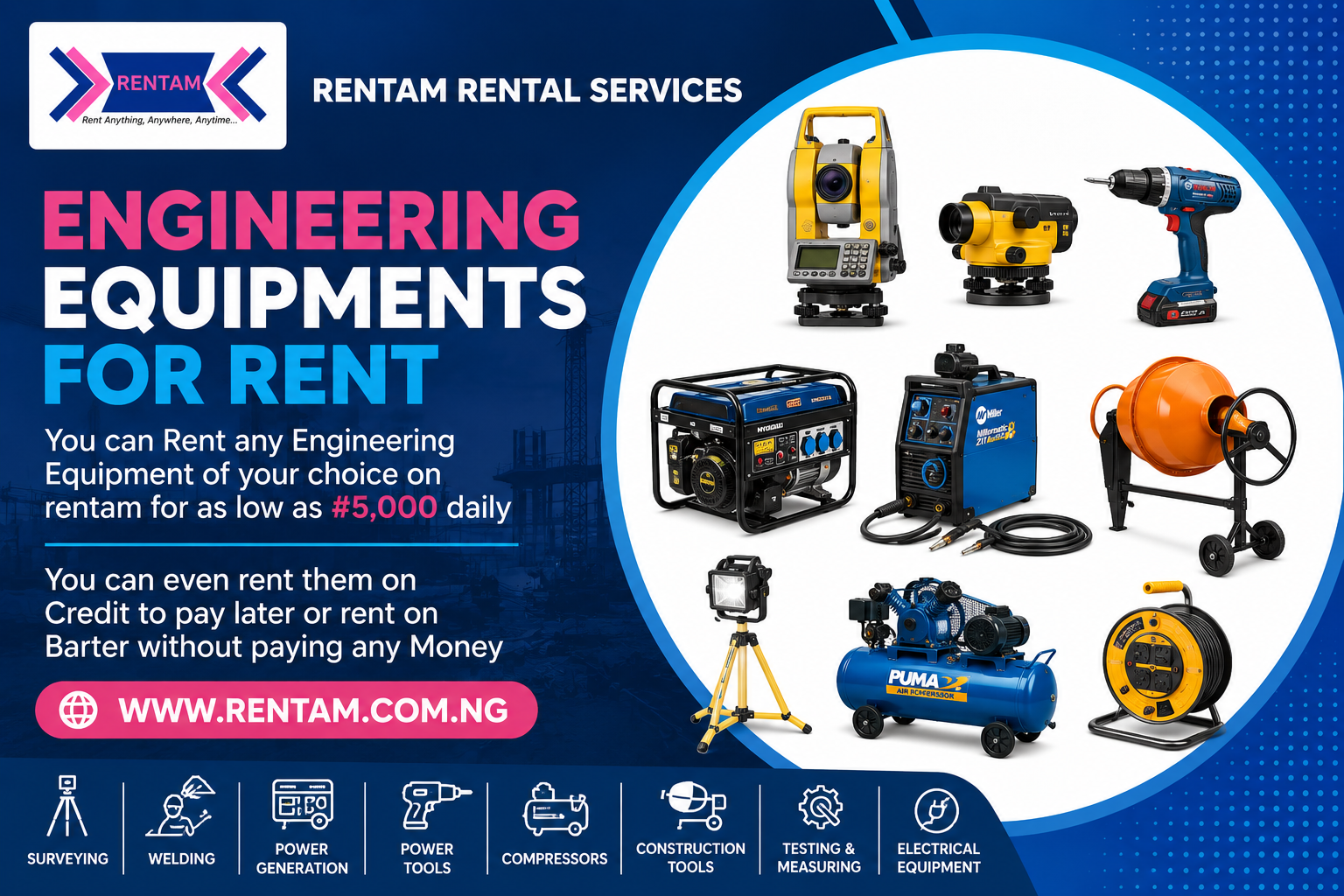
Engineering equipment on Rentam spans several functional groups: surveying and positioning instruments, geotechnical and material testing equipment, structural testing equipment, mechanical fabrication and installation equipment, electrical and instrumentation testing equipment, environmental and specialized testing equipment, and design and digital engineering equipment including CAD workstations, 3D scanners, and 3D printers. Each of these serves engineers whose professional judgment depends on instrumentation they cannot always justify owning outright — and each is available on Rentam for exactly the project, assessment, or research period it is needed.
What Is the Engineering Equipment Category on Rentam?
Rentam organises its listings into focused categories so engineering professionals can find exactly the instrument a specific project phase, investigation, or test demands, without wading through unrelated listings. The Engineering Equipment category holds particular importance on our platform, because the accuracy of this equipment underpins formal engineering conclusions, certifications, and, ultimately, structural and public safety.
Think of Rentam’s Engineering Equipment section as a professionally verified instrument library — one that exists on your phone or computer, is accessible from anywhere in Nigeria, and connects you only to listings with documented condition and, where applicable, verified calibration status. Unlike sourcing engineering instrumentation informally with no clear record of when it was last calibrated or how it has been maintained, renting through Rentam means you know the instrument’s specifications, condition, calibration currency where relevant, cost, and what recourse exists should a reading come into question.
The category covers surveying and positioning equipment, geotechnical and material testing equipment, structural and mechanical testing equipment, fabrication and installation equipment, electrical and instrumentation testing equipment, environmental and specialized monitoring equipment, and design and digital engineering tools. Each of these has its own listing standards, rental duration structures, and relevant user groups — and we will walk through them all in this guide.
Total Stations, Automatic Levels, Theodolites, and Digital Levels
Surveying forms the foundation of virtually every civil and structural engineering project, and total stations, automatic levels, theodolites, and digital levels are the core instruments that establish the precise coordinates, elevations, and angles engineering design and construction depend on. Total stations combine angle and distance measurement for comprehensive site surveying. Automatic and digital levels establish precise elevation reference points. Theodolites measure horizontal and vertical angles with high precision for specialized surveying applications. A total station costs ₦2 million to ₦6 million, a significant investment for a firm whose survey work is real but not continuous enough to justify permanent ownership.
Rentam lists total stations for comprehensive land and construction surveying, automatic and digital levels for precise elevation work, and theodolites for specialized angular measurement applications.
A civil engineering consultancy in Abuja awarded a site survey contract for a new development can rent a total station for the survey’s duration, deliver precise, professionally documented survey data, and return the instrument rather than committing millions of naira to equipment used only when survey contracts arise. A structural engineer in Lagos verifying building settlement over time can rent an automatic level for periodic monitoring readings, track movement accurately, and avoid owning an instrument needed only for scheduled monitoring visits. Surveying instruments establish the precise foundation every engineering project builds upon. Rentam makes that precision accessible without the capital weight of ownership.
GPS Survey Equipment and Survey Drones
Beyond conventional surveying instruments, modern engineering practice increasingly depends on GPS survey equipment for establishing precise geographic coordinates across large sites, and survey drones for rapid aerial data capture across topography that would take conventional survey methods days or weeks to cover. A professional GPS survey system costs ₦1.5 million to ₦5 million, and a survey-grade drone with mapping capability adds a similarly significant investment.
Rentam lists GPS survey equipment for precise coordinate establishment and land demarcation, and survey drones equipped for topographic mapping and large-site data capture.
A land surveying firm in Kano State handling a large agricultural land demarcation project can rent GPS survey equipment for the project’s duration, complete precise, legally defensible boundary work, and return the equipment once the survey concludes. An infrastructure consultancy in Port Harcourt conducting a topographic assessment across an extensive proposed road corridor can rent a survey drone for the mapping phase, capture comprehensive site data far faster than ground survey alone, and avoid the cost of equipment used only for occasional large-site assessments. Modern positioning technology accelerates engineering data collection dramatically. Rentam makes that acceleration accessible without disproportionate investment.
Ground Penetrating Radar and Geotechnical Testing Equipment
Understanding what lies beneath the ground — utility lines, subsurface structures, soil composition, and geological conditions — is essential before excavation, foundation design, or underground utility work proceeds safely. Ground Penetrating Radar (GPR) units reveal subsurface features without invasive excavation. Soil testing equipment assesses ground conditions critical to foundation design decisions. This equipment is highly specialized, used intensively during specific site investigation phases and largely idle otherwise. A GPR unit costs ₦3 million to ₦8 million, putting it well beyond routine ownership for most engineering consultancies.
Rentam lists GPR units for non-invasive subsurface investigation, and soil testing equipment including penetrometers and sampling tools for geotechnical assessment.
A geotechnical engineer in Lagos investigating potential underground utility conflicts before a foundation excavation can rent a GPR unit for the investigation day, identify buried infrastructure without risking damage during excavation, and return the equipment once the investigation is complete. A structural engineering firm assessing soil bearing capacity ahead of a foundation design can rent soil testing equipment for the site investigation phase, gather the data needed to inform safe foundation design, and avoid owning instrumentation used only during specific pre-construction investigations. Subsurface investigation equipment prevents costly and dangerous surprises during construction. Rentam makes that investigation accessible without extraordinary specialized investment.
Concrete Testing, Material Testing, and Compression Testing Equipment
Verifying that concrete, steel, and other construction materials meet design specification is fundamental to structural engineering sign-off and quality assurance. Concrete testing equipment, including slump test kits and concrete strength testers, verifies fresh and cured concrete quality. Compression testing machines and broader material testing equipment verify that materials meet the strength and performance criteria engineering designs depend upon. A quality compression testing machine costs ₦2 million to ₦8 million, an investment justified for laboratories and testing companies with continuous demand but rarely for individual engineers or smaller firms.
Rentam lists concrete testing equipment for fresh and cured concrete quality verification, and compression testing machines and broader material testing equipment for verifying material strength and performance to engineering standards.
A structural engineer in Enugu contracted to verify concrete quality on an active construction site can rent concrete testing equipment for the testing schedule required across the project’s concrete pours, deliver properly documented quality assurance, and return the equipment once testing concludes. An engineering consultancy conducting periodic material verification for a manufacturing client can rent a compression testing machine for the specific testing campaign, generate the certified data the engagement requires, and avoid the substantial cost of permanent laboratory-grade testing equipment. Material testing equipment underpins engineering confidence in what gets built. Rentam makes that confidence accessible without the capital burden testing laboratories typically carry.
Universal Testing Machines and Hydraulic Presses
For more comprehensive material and component testing — tensile strength, yield point, elongation, and a range of mechanical properties — universal testing machines provide the versatility engineering research, quality assurance, and product development depend upon. Hydraulic presses support forming, testing, and pressing applications across mechanical and structural engineering work. A universal testing machine represents one of the more substantial investments in engineering test equipment, often costing ₦4 million to ₦15 million depending on capacity and precision.
Rentam lists universal testing machines for comprehensive mechanical property testing, and hydraulic presses for forming, testing, and structural verification applications.
A mechanical engineering department at a university in Ilorin running a specific research project requiring material property data beyond its permanent laboratory capacity can rent a universal testing machine for the research period, generate the data the study requires, and return the equipment once the project concludes. A manufacturing quality assurance team conducting a specific product testing campaign can rent the appropriate testing equipment for that campaign’s duration rather than maintaining capacity exceeding routine need. Universal testing machines answer engineering’s most fundamental material questions. Rentam makes that answer accessible for exactly the project or study that requires it.
Hydraulic Jacks, Torque Wrenches, and Precision Fabrication Equipment
Engineering installation, commissioning, and maintenance work depends on precision mechanical tools — hydraulic jacks for controlled lifting and load application, calibrated torque wrenches for precise fastening to engineering specification, and related fabrication equipment supporting mechanical and structural installation work. Precision here matters enormously — an improperly torqued bolt on structural or mechanical equipment can represent a genuine safety risk, making calibrated instrumentation essential rather than optional.
Rentam lists hydraulic jacks for controlled lifting and load testing applications, and calibrated torque wrenches for precision fastening across mechanical and structural engineering work.
A mechanical engineer overseeing equipment installation at an industrial facility can rent calibrated torque wrenches for the installation and commissioning period, ensure every fastening meets specified torque values, and return the equipment once commissioning is verified complete. A structural engineering team conducting load testing on an existing structure can rent hydraulic jacks appropriate to the testing load requirements, execute the assessment safely and to specification, and avoid owning specialized load-testing equipment used only during periodic structural assessments. Precision mechanical tools protect the integrity of engineering installation and testing work. Rentam makes that precision accessible without constant specialized ownership.
Welding Machines, Cutting Machines, and Pipe Fabrication Equipment
Engineering fabrication and installation work — particularly in mechanical, structural, and petroleum engineering contexts — depends on welding, cutting, and pipe preparation equipment for on-site and workshop fabrication tasks. Welding machines join structural and mechanical components. Cutting machines shape materials to engineering specification. Pipe threading and bending equipment prepares piping systems for installation according to precise engineering design requirements.
Rentam lists welding machines including MIG, TIG, and specialized welding equipment for engineering fabrication work, cutting machines for precision material shaping, and pipe threading and bending equipment for piping system fabrication.
An engineering firm executing a piping installation project for an industrial client can rent pipe threading and bending equipment for the fabrication phase, complete the installation to design specification, and return the equipment once the project’s fabrication work concludes. A structural fabrication team handling a specific project requiring specialized welding beyond their standard capacity can rent additional welding equipment for that project’s duration, meet the engineering specification required, and avoid permanent investment in capacity exceeding typical demand. Fabrication equipment turns engineering design into physically realized structures and systems. Rentam makes that realization accessible without excess capital tied up in equipment.
Power Generators and Air Compressors for Engineering Operations
Engineering fieldwork, testing, and commissioning activities frequently occur at sites without reliable power infrastructure, making portable generators and compressed air systems essential supporting equipment for many engineering operations. This equipment supports the broader engineering task at hand rather than performing the core engineering function itself, but its absence can halt an entire testing or commissioning process.
Rentam lists power generators in various capacities for field engineering operations, and air compressors for pneumatic tools and processes supporting engineering fieldwork.
A commissioning engineer verifying equipment performance at a remote industrial site with unreliable grid power can rent a generator for the commissioning period, ensure uninterrupted power for testing instrumentation, and return the equipment once commissioning concludes. This supporting infrastructure keeps engineering fieldwork moving regardless of site conditions. Rentam makes it accessible exactly when field conditions demand it.
Electrical Testing Equipment — Multimeters, Clamp Meters, Oscilloscopes, and Power Quality Analyzers
Electrical engineering work, whether in building services, industrial systems, or utility infrastructure, depends on a core set of measurement and diagnostic instruments. Digital multimeters and clamp meters support general electrical measurement and troubleshooting. Oscilloscopes visualize electrical signals for diagnosing complex control and electronic system behaviour. Power quality analyzers diagnose voltage irregularities, harmonics, and power factor issues affecting engineered electrical systems.
Rentam lists digital multimeters and clamp meters for electrical measurement and diagnostics, oscilloscopes for signal analysis on electronic and control systems, and power quality analyzers for diagnosing power supply irregularities.
An electrical engineer commissioning a new industrial electrical installation can rent a power quality analyzer for the commissioning period, verify the system meets design and regulatory standards before handover, and return the instrument once commissioning documentation is complete. This core instrumentation underpins electrical engineering verification and troubleshooting. Rentam makes it accessible for exactly the commissioning or diagnostic task it serves.
Thermal Imaging Cameras, Insulation Testers, and Earth Testers
Electrical safety verification and thermal diagnostics depend on specialized instruments used periodically rather than continuously by most engineering practitioners. Thermal imaging cameras reveal temperature anomalies indicating electrical faults or thermal inefficiencies. Insulation resistance testers verify wiring safety compliance. Earth testers confirm grounding systems meet engineering and regulatory safety standards.
Rentam lists thermal imaging cameras for electrical and building diagnostic applications, insulation resistance testers for wiring safety verification, and earth testers for grounding system compliance checks.
An electrical engineering consultancy conducting a scheduled safety audit for an industrial client can rent a thermal camera, insulation tester, and earth tester for the audit period, deliver a properly documented compliance report, and return the instruments once the engagement concludes. This equipment protects against electrical hazards before they become failures. Rentam makes that protection accessible for exactly the audit or inspection it serves.
Fiber Optic Testing Equipment, Gas Detectors, and Environmental Monitoring Equipment
Telecommunications and environmental engineering disciplines depend on specialized testing categories of their own. Fibre optic testing equipment, including OTDRs and fusion splicers, supports telecommunications infrastructure installation and verification. Gas detectors protect engineers and technicians entering confined or potentially hazardous spaces during inspection or maintenance work. Environmental monitoring equipment supports environmental engineering assessments and regulatory compliance work.
Rentam lists fibre optic testing equipment for telecommunications infrastructure verification, gas detectors for confined space and hazardous environment safety, and environmental monitoring equipment for air quality and compliance assessment.
A telecommunications engineering firm commissioning a new fibre network can rent OTDR and fusion splicing equipment for the commissioning period, verify network integrity to specification, and return the equipment once the project is signed off. An environmental engineer conducting a site assessment can rent monitoring equipment for the assessment period, gather the data required for a compliance report, and avoid the cost of specialized equipment used only for periodic consulting engagements. Rentam makes this specialized instrumentation accessible without disproportionate ownership cost.
Calibration Instruments and Precision Measuring Instruments
Engineering practice depends fundamentally on trustworthy measurement, and calibration instruments — used to verify that other measuring devices remain accurate — along with precision measuring instruments like calipers, micrometers, and dimensional gauges, support both quality assurance and ongoing instrument reliability across engineering disciplines.
Rentam lists calibration reference instruments for verifying measurement equipment accuracy, and precision measuring instruments for dimensional and mechanical measurement applications.
A quality engineer responsible for periodic verification of a facility’s measurement instruments can rent calibration reference equipment for the verification exercise, confirm instrument accuracy across the facility, and return the equipment once the check is complete. Calibration and precision measurement underpin trust in every other engineering measurement taken. Rentam makes that underlying trust accessible without constant specialized investment.
Laboratory Engineering Equipment, CAD Workstations, 3D Scanners, and 3D Printers
Engineering design, research, and education increasingly depend on digital and laboratory tools beyond field instrumentation. Laboratory engineering equipment supports academic and research testing across disciplines. CAD workstations provide the computing power engineering design software demands. 3D scanners capture precise as-built or physical geometry for engineering documentation and reverse engineering applications. 3D printers support rapid prototyping for mechanical design verification and educational demonstration.
Rentam lists laboratory engineering equipment for academic and research testing applications, CAD workstations equipped for engineering design software, 3D scanners for precise geometric capture, and 3D printers for prototyping and educational applications.
An engineering department at a polytechnic in Ibadan running a specific student design project can rent CAD workstations and a 3D printer for the project’s academic term, support quality student work without permanent computing lab expansion, and return the equipment once the term concludes. A mechanical engineering consultancy needing to reverse-engineer an existing component can rent a 3D scanner for the specific project requiring that capability, capture precise geometric data, and return the equipment once the task is complete. Digital engineering tools bring modern design and documentation capability within reach. Rentam makes that capability accessible for exactly the project or term it serves.
Rental Duration Options for Engineering Equipment on Rentam
Engineering equipment needs are tied closely to specific projects, investigations, commissioning processes, and academic terms, and Rentam’s rental duration structure reflects this reality. Daily and short-term rentals suit single investigations or testing sessions — a GPR unit for a subsurface investigation day, a compression tester for a specific pour verification. Weekly rentals apply to project phases requiring sustained equipment access — a total station for a survey contract, fibre testing equipment for a commissioning phase. Monthly rentals suit equipment needed across an extended project or academic term — laboratory instruments for a research project, CAD workstations for a semester-long design course. Project-based rentals are available for equipment needed from a project’s start to its completion, with duration tied to the actual engineering project timeline.
We understand that a total station is needed for the precise duration a survey contract requires, and that a GPR investigation happens on a specific day, not according to a fixed billing cycle. Rentam’s Engineering Equipment rental durations are built to match actual project and academic timelines rather than administrative convenience.
How Engineering Equipment Listings Are Verified — Functional Testing and Calibration Checks
Because engineering equipment exists to produce data that underpins professional judgment and, often, formal certification, Rentam applies a verification standard to this category that reflects those genuine professional stakes. Equipment owners listing instruments in this category are required to provide documentation confirming ownership, evidence of current functional condition, and — for calibration-sensitive equipment such as testing machines, survey instruments, and electrical testing equipment — confirmation of calibration status and, where maintained, calibration certificates or records of the most recent calibration date.
Every listing undergoes functional testing verification before approval, confirming instruments genuinely perform to specification rather than simply appearing intact. Listings that misrepresent condition, specifications, or calibration status are removed from the platform immediately, and owners found to have misrepresented these details are subject to account suspension. Verified listings are marked clearly, and for equipment supporting formal engineering certification or sign-off specifically, we encourage renters to review calibration documentation directly before committing critical work to a rented instrument. We cannot eliminate every risk inherent in precision instrumentation, but we can and do eliminate the most damaging one: engineering conclusions built on equipment with no verifiable confidence behind it.
Transparent Pricing and Flexible Payment Options
Every Engineering Equipment listing on Rentam states its rental rate clearly — daily, weekly, monthly, or project-based — with all additional costs, including delivery, installation or setup support, and refundable security deposits, disclosed upfront. There are no surprise charges once an engineer or firm has committed project deliverables to a piece of rented equipment.
We also recognise that engineering firms, particularly independent consultants and smaller practices, do not always have capital available at the exact moment a project requiring specific instrumentation arises. Our Rent Now, Pay Later option allows qualified renters to access equipment immediately with structured payment terms tied to realistic project cash flow. Our Barter option, facilitated through the JummikPlus Barter Purchase Service, allows equipment access to be offset through assessed value in goods or services. Our Union option allows groups of independent engineers or smaller firms to pool resources for equipment none of them could justify individually — several structural engineers sharing a universal testing machine’s rental cost across separate but concurrent assessments, for instance. And discount pricing applies to extended project-based rentals and repeat institutional bookings.
Responsible Use, Engineering Standards Compliance, and Safety Expectations
Engineering equipment demands particular rigour, both because instruments are often delicate and expensive, and because the data they produce feeds directly into professional engineering judgment with real safety implications. Rentam expects equipment owners to deliver instruments in genuinely functional, properly calibrated condition where calibration applies, disclose any known limitations clearly, and provide relevant technical documentation supporting proper use.
For renters, we expect equipment to be operated by individuals with relevant engineering competence, particularly for safety-critical testing and structural assessment equipment, that instruments are protected from conditions that could compromise their calibration or function, that any malfunction or suspected inaccuracy is reported immediately rather than proceeding on questionable data, and that equipment is returned at the agreed time in the condition received, with normal professional use wear excepted. Engineering conclusions carry real safety and structural consequences; these expectations exist to ensure both parties act in good faith so that instrumentation remains trustworthy for the next engineer who depends on it.
How to Search and Rent Engineering Equipment on Rentam
You can visit rentam.com.ng and navigate to the Engineering Equipment category, searching directly by equipment type and location — “total station, Abuja” or “compression testing machine, Lagos” — or browsing listings with filters for equipment type, location, rental duration, and price range. Review the full listing details, including technical specifications, condition, calibration status where applicable, rental rate, and delivery or installation terms. For straightforward equipment, proceed directly through Rentam’s secure booking and payment process. For larger, more technically complex, or calibration-critical rentals, we facilitate structured communication so all terms — including calibration documentation and any installation support — are agreed and documented before commitment. After confirmation, equipment is delivered and, where applicable, set up at your site or facility, with full documentation retained throughout the rental period for dispute resolution if needed.
Frequently Asked Questions (FAQ)
Q1. Can I obtain a calibration certificate for engineering instruments I rent, particularly for testing or certification work?
Where the equipment owner maintains calibration documentation, this is made available as part of the listing. For work requiring formal certification — material testing for structural sign-off, for example — we encourage renters to confirm calibration currency and documentation directly before booking, since not every listing carries formal third-party calibration certification by default.
Q2. Is technical or installation support available for more complex engineering equipment?
Many equipment owners provide basic setup guidance at handover, and some listings for more complex instrumentation, such as CAD workstations or 3D scanning equipment, include a brief orientation. For highly specialized equipment, we recommend confirming your team’s familiarity with the instrument or requesting operator support before booking.
Q3. What happens if rented equipment produces questionable or inconsistent readings during a critical assessment?
Report this to Rentam immediately rather than proceeding on uncertain data. If the issue stems from a pre-existing calibration or functional fault, the equipment owner is responsible for resolution, and our dispute process is available. Given the professional stakes involved in engineering data, we treat these disputes with particular urgency.
Q4. Can I rent engineering equipment for a single site investigation or test?
Yes. Many listings, particularly GPR units, concrete testing equipment, and survey instruments, support daily rental specifically suited to single investigations, tests, or site visits.
Q5. Is delivery available for larger or more sensitive instruments like total stations and testing machines?
This varies by listing. Given the sensitivity of much of this equipment, many owners prefer careful direct handover or coordinated delivery rather than standard shipping; each listing states its specific delivery terms.
Q6. What if I damage a rented instrument during a project?
If damage results from renter mishandling, the renter is responsible for repair or replacement cost, which is why most listings require a refundable security deposit reflecting the instrument’s value. If a fault existed before the rental began, the owner is responsible, and Rentam’s dispute process addresses any disagreement fairly.
Q7. I own engineering equipment that sits idle between projects. Can I list it and earn from it?
Absolutely, and we actively encourage it. Idle engineering instruments represent dead capital that also loses calibration relevance the longer they sit unused. Listing your equipment on Rentam allows other engineers and firms to access it during your downtime, while you earn from an asset that would otherwise simply depreciate in storage.
Conclusion — Engineer with Confidence. Invest with Precision.
Engineering judgment in Nigeria — whether verifying a foundation’s soil conditions, certifying a structure’s material strength, commissioning an electrical system, or surveying land for a new development — depends entirely on the reliability of the instruments behind it. For too long, that reliability has been available in full only to the largest firms and institutions able to absorb the enormous capital cost of engineering-grade instrumentation, while independent engineers, smaller consultancies, and academic institutions have had to make do with less, or gamble on informally sourced equipment of uncertain calibration.
Rentam Rental Services was built on the conviction that this does not have to be the case. We believe an independent structural engineer in Enugu should be able to access a properly calibrated compression testing machine with the same confidence as a major engineering firm in Lagos. We believe a small survey practice should be able to rent a total station for a single contract without the extraordinary capital burden of owning one outright. And we believe that flexible payment options — including Rent Now Pay Later, Barter, and Union arrangements — should meet Nigeria’s engineers and engineering institutions where their project realities and cash flow actually are.
Through the Engineering Equipment category on Rentam, that conviction is now practical. Every listing on our platform is an opportunity — to survey the site precisely, to test the material with certainty, to commission the system to specification, to investigate the subsurface before excavation, and to deliver engineering work Nigeria can trust, without the crushing cost of owning every instrument that trust depends on.
If you are ready to access the engineering equipment your project, practice, or research demands — or ready to earn from instruments you own but use only occasionally — visit rentam.com.ng today. Browse the Engineering Equipment category, find the precision your next assignment requires, and take the first step toward engineering work backed by instrumentation you can genuinely trust.
You have the expertise and the projects. We have the instruments to back your judgment.
Visit rentam.com.ng or call/chat on 08036830251 to get started.



 Technical Equipment Rentals on Rentam: Your Complete Guide to Renting Technical and Diagnostic Equipment in Nigeria
Leave a Reply