From Excavators to Piling Rigs: Everything You Can Rent in Rentam’s Heavy Duty Equipment Category
A single excavator can cost more than the entire budget of the project it’s needed for — and that is precisely the problem Nigerian contractors face every single day. When the machine you need costs more than the job you’re bidding on, ownership stops being an option and starts being an obstacle. Rentam exists to remove that obstacle.
Few business decisions carry as much financial weight as the decision to acquire heavy-duty equipment in Nigeria. A road construction firm in Kaduna State bidding on a forty-kilometre rehabilitation contract needs motor graders, rollers, and an asphalt paver to execute the work, yet a single motor grader alone can cost ₦80 million to ₦150 million new, and a quality asphalt paver runs even higher. A mid-sized engineering company in Port Harcourt wins a contract requiring a mobile crane for structural steel installation, but the crane’s purchase price — often ₦100 million or more for a capacity suited to serious commercial lifting — exceeds the total value of several contracts combined. A logistics operator at the Lagos ports needs a reach stacker to handle container movement during a specific shipping surge, and the machine’s price tag makes permanent ownership viable only for operators running continuous, year-round container traffic at genuinely industrial scale.
This is the defining tension of heavy-duty equipment ownership in Nigeria: the machines that make large-scale construction, mining, infrastructure development, and industrial logistics possible are also the machines least likely to be affordable to the businesses that need them most. Beyond the staggering purchase price, heavy equipment carries a weight of ongoing costs that dwarfs almost any other category of business asset — fuel consumption on machines that can burn through tens of litres of diesel per hour, maintenance and repair costs from specialized technicians and imported spare parts, operator salaries for trained personnel qualified to run million-naira machinery safely, transportation and mobilization logistics to move equipment from site to site, insurance premiums reflecting genuine catastrophic risk, and depreciation that erodes resale value steadily whether the machine works every day or sits idle in a yard.
And critically, much of this equipment is needed only for the duration of a specific project. An excavator is essential during a foundation excavation phase and irrelevant once the building rises above ground level. A pile driving rig works intensively during a project’s foundation stage and has no further role once piling is complete. A concrete batching plant serves a specific construction phase requiring high-volume concrete production and then sits unused until the next comparable project arrives — if it ever does. A contractor who buys a crane to fulfill one lifting-heavy contract may find that contract was the last of its kind for the next eighteen months, leaving millions of naira in capital standing idle in a yard, still accruing depreciation, insurance, and storage costs regardless of whether it works a single day.
The traditional Nigerian response to this mismatch — informal machinery hire through personal networks, verbal agreements with equipment owners of uncertain reliability, and no documented accountability for breakdowns or safety compliance — carries risks that scale with the size and danger of the equipment itself. A generator that breaks down mid-project causes delay; a crane with an undisclosed structural fault, or an excavator operated by someone without proper training, can cause catastrophic accidents, serious injury, or loss of life. For heavy-duty equipment specifically, the gap between informal hire and structured, verified rental is not a matter of convenience — it is a matter of genuine safety and project viability.
What Nigerian construction, mining, infrastructure, and industrial sectors have needed is a structured, verified, and accountable way to access heavy machinery precisely when a project demands it — without the crushing capital burden, the operator and maintenance overhead, and the depreciation risk of outright ownership, and without compromising on the safety standards this category of equipment absolutely demands. Rentam Rental Services was built to provide exactly that. Through the Heavy Duty Equipment category on our platform, we have created a marketplace where construction companies, mining firms, road contractors, engineering companies, logistics providers, industrial businesses, government agencies, oil and gas companies, agricultural enterprises, infrastructure developers, and individuals across Nigeria can access the largest, most demanding machinery their projects require, with the verification, documentation, and accountability that heavy equipment work absolutely demands.
This guide covers everything you need to know about Rentam’s Heavy Duty Equipment category. We explain what heavy duty equipment is, describe each major equipment type available on the platform, tell you who each type serves, and walk you through how to rent with confidence. Whether you run a construction company, an engineering firm, a mining operation, or a logistics business, this guide is written for you.
What Is Heavy Duty Equipment?
Heavy duty equipment refers to large, high-capacity machinery designed for earthmoving, excavation, lifting, demolition, mining, infrastructure development, heavy transportation, and material handling at a scale that exceeds general construction and industrial equipment. This distinguishes the category from Rentam’s Construction Equipment section, which covers site-level machinery like concrete mixers and scaffolding, and from Industrial Equipment, which covers manufacturing and factory-floor machinery. Heavy Duty Equipment is defined by scale and mechanical power — these are the machines measured in tonnes of operating weight and hundreds of horsepower, typically requiring trained, often certified, operators and careful mobilization logistics to move between sites.
In everyday Nigerian project contexts, this is the machinery you see on major infrastructure projects, mining sites, ports, and large-scale construction — the excavators digging deep foundations and trenches, the bulldozers clearing and grading extensive land areas, the cranes lifting structural steel and precast components into place, the dump trucks hauling earth and aggregate at volume, and the drilling rigs boring deep into the ground for piling and geotechnical work.
Heavy duty equipment on Rentam spans several functional groups: earthmoving and excavation equipment, lifting and material handling equipment, heavy haulage and transportation equipment, road construction and surfacing equipment, foundation and piling equipment, concrete production equipment, and specialized mining and demolition equipment. Each category serves projects and operations whose scale genuinely demands this class of machinery — and each is available on Rentam for exactly the project duration it is needed.
What Is the Heavy Duty Equipment Category on Rentam?
Rentam organises its listings into focused categories so contractors and operators can find exactly the machine a project’s scale and phase demands, without wading through smaller equipment listings that do not fit the task. The Heavy Duty Equipment category carries particular weight on our platform — literally and in terms of the rigour we apply — given the scale, cost, and safety stakes involved.
Think of Rentam’s Heavy Duty Equipment section as a structured, verified equipment yard — one that exists on your phone or computer, is accessible from anywhere in Nigeria, and connects you only to documented rental arrangements with mechanically verified equipment. Unlike sourcing a crane or excavator through informal industry contacts with no clear documentation of maintenance history, operator qualification, or liability in case of accident, renting through Rentam means you know the equipment’s specifications and condition, whether a qualified operator is included, what it costs, how long you can have it, and what happens if a breakdown occurs mid-project.
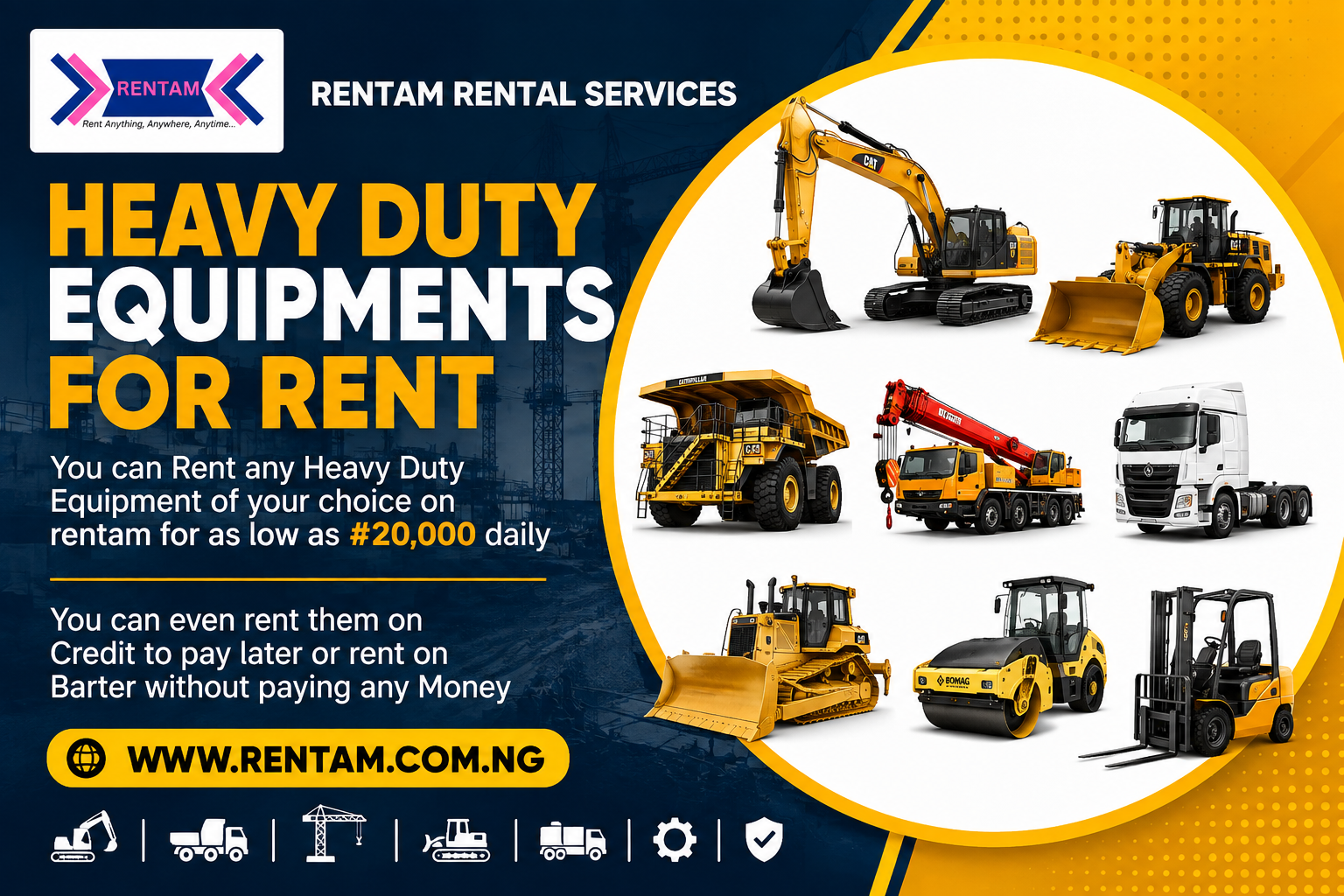
The category covers earthmoving and excavation equipment including excavators, bulldozers, and loaders, lifting equipment including mobile and tower cranes, heavy haulage equipment including dump trucks and low bed trailers, road construction equipment including graders, rollers, and asphalt pavers, foundation and piling equipment including drilling rigs and pile drivers, concrete production equipment including batching plants and concrete pumps, and specialized mining, demolition, and port-handling equipment. Each of these has its own listing standards, rental duration structures, and relevant user groups — and we will walk through them all in this guide.
Excavators, Bulldozers, and Backhoe Loaders — The Core of Earthmoving
Every major construction and infrastructure project begins with earthmoving, and excavators, bulldozers, and backhoe loaders form the core machinery for this work. Excavators dig foundations, trenches, and basements with precision. Bulldozers clear, grade, and push large volumes of earth across extensive areas. Backhoe loaders combine digging and loading capability, versatile for medium-scale earthmoving and utility work. A standard excavator costs ₦50 million to ₦200 million or more, a bulldozer follows a similar range, and even a backhoe loader — the most accessible of the three — costs ₦25 million to ₦60 million.
Rentam lists mini and standard excavators for foundation, trenching, and general excavation work, bulldozers for land clearing and large-scale grading, and backhoe loaders for combined digging and loading tasks on medium-scale projects.
A construction firm in Lagos breaking ground on a commercial development can rent a standard excavator for the foundation excavation phase — typically three to four weeks — complete the earthworks professionally, and return the machine rather than committing tens of millions of naira to equipment needed for a fraction of the project’s total timeline. A road contractor clearing land ahead of a rural highway project in Taraba State can rent a bulldozer for the clearing phase specifically, and a utility contractor in Enugu laying underground cabling can rent a backhoe loader for the trenching work required. Earthmoving machinery makes every large project possible from the ground up. Rentam makes that machinery accessible without the extraordinary capital burden of ownership.
Wheel Loaders, Skid Steer Loaders, and Motor Graders
Beyond primary excavation, projects require loaders for moving and loading bulk materials, and graders for precise surface levelling — particularly critical in road construction and site preparation. Wheel loaders handle high-volume material loading onto trucks. Skid steer loaders offer compact, manoeuvrable capability for confined worksites. Motor graders create precisely level and cambered surfaces essential for road construction quality. A motor grader alone can cost ₦80 million to ₦150 million, reflecting the precision engineering required for accurate surface work.
Rentam lists wheel loaders for bulk material handling and loading operations, skid steer loaders for compact-site material movement, and motor graders for road construction and precise surface levelling.
A quarry operation in Ogun State loading aggregate onto haulage trucks continuously can rent a wheel loader for the operation’s active period, maintain efficient loading throughput, and return the machine between major contracts. A road contractor in Kaduna State awarded a highway rehabilitation contract can rent a motor grader for the surface preparation phase specifically, achieve the precise grading quality the contract specification demands, and return the machine once that phase concludes. Loaders and graders turn raw earthwork into properly prepared, level surfaces. Rentam makes that precision accessible without the enormous cost of permanent ownership.
Dump Trucks, Tipper Trucks, and Low Bed Trailers — Heavy Haulage
Moving earth, aggregate, demolished material, and the heavy machinery itself between sites requires a dedicated haulage fleet. Dump trucks and tipper trucks move bulk material from excavation sites to disposal or stockpile locations. Low bed trailers transport heavy machinery — excavators, bulldozers, cranes — between project sites, a specialized transportation task requiring appropriate trailer capacity and, often, permits for oversized loads. A heavy-duty tipper truck costs ₦40 million to ₦90 million, and a low bed trailer suited to hauling excavators and similar machinery adds significant further cost.
Rentam lists dump trucks and tipper trucks in various tonnage capacities for material haulage, and low bed trailers for transporting heavy machinery between project sites.
A construction company in Abuja managing a large excavation project can rent a fleet of tipper trucks for the spoil removal phase, move excavated material efficiently to disposal sites, and return the trucks once earthworks conclude. A contractor needing to mobilize an excavator from one project site to another across state lines can rent a low bed trailer for the transport, move the machine safely and legally, and avoid the cost of owning specialized haulage equipment used only during mobilization between projects. Haulage equipment keeps materials and machinery moving where projects need them. Rentam makes that movement accessible without a dedicated fleet investment.
Mobile Cranes and Tower Cranes — Heavy Lifting Solutions
Structural steel, precast concrete elements, heavy equipment installation, and high-rise construction all depend on cranes capable of lifting loads far beyond human or forklift capacity. Mobile cranes offer flexible, road-transportable lifting capability for varied project sites. Tower cranes provide the height and reach essential for high-rise building construction, remaining fixed at a single site for the duration of a build. A mobile crane with serious lifting capacity costs ₦100 million to ₦300 million or more, while tower crane investment, including installation, runs into similarly formidable figures.
Rentam lists mobile telescopic cranes for general construction and industrial lifting, and tower cranes for high-rise building construction requiring sustained height and reach over an extended project timeline.
An engineering firm in Port Harcourt contracted to install structural steel for a commercial building can rent a mobile crane for the installation phase — typically several weeks — complete the lifting work safely and professionally, and return the crane once structural steel work concludes. A property developer in Lagos constructing a high-rise residential tower can rent a tower crane for the building’s construction duration, access the height and reach the project demands, and avoid the extraordinary capital cost of owning equipment with a single-project use case. Cranes make possible what no other equipment can lift. Rentam makes that lifting capability accessible without the massive capital outlay ownership requires.
Forklifts, Reach Stackers, and Telehandlers — Material Handling at Scale
Warehouses, ports, and industrial yards depend on specialized material handling equipment beyond standard forklifts for genuinely heavy-duty loads. Reach stackers handle container movement at ports and large logistics yards. Telehandlers combine lifting height and reach for construction sites and agricultural operations, handling loads that standard forklifts cannot manage. This equipment represents significant investment for operations whose material handling volume fluctuates with shipping schedules, seasonal demand, or specific project phases.
Rentam lists heavy-capacity forklifts for industrial and warehouse material handling, reach stackers for container handling at ports and logistics facilities, and telehandlers for construction and agricultural lifting applications.
A logistics operator at the Lagos ports experiencing a shipping volume surge can rent a reach stacker for the surge period, maintain container handling efficiency during peak throughput, and return the equipment once volumes normalize. A construction contractor in Abuja needing to lift building materials to upper floors during a multi-storey project can rent a telehandler for the active construction phase, and return it once that phase of work concludes. Heavy material handling equipment keeps goods and materials moving at industrial scale. Rentam makes that capacity available exactly when volume or project demand requires it.
Rollers, Asphalt Pavers, and Soil Compactors — Road Construction Equipment
Building durable roads requires a sequence of specialized equipment — soil compactors and rollers to prepare and consolidate the sub-base, and asphalt pavers to lay the finished road surface with precision. This equipment is intensely project-specific, used heavily during active road construction phases and having little application outside road and pavement work. A vibratory roller costs ₦30 million to ₦80 million, and an asphalt paver represents an even larger investment, often exceeding ₦150 million.
Rentam lists vibratory rollers for soil and asphalt compaction, asphalt pavers for laying road surface material, and soil compactors for foundation and sub-base preparation across construction and road projects.
A road contractor in Anambra State awarded a highway rehabilitation contract can rent a complete set of rollers and an asphalt paver for the surfacing phase, execute the paving work to specification, and return the equipment once the contract concludes, rather than owning machinery with essentially no application outside road construction work. Road construction equipment turns raw earthwork into durable, usable infrastructure. Rentam makes that final, critical phase accessible without a fleet-level capital commitment.
Trenchers, Drilling Rigs, and Pile Driving Equipment — Foundation and Utility Work
Deep foundation work and utility installation depend on specialized boring, trenching, and piling equipment. Trenchers excavate narrow, precise trenches for utility lines efficiently. Drilling rigs bore deep into the ground for geotechnical investigation, water wells, or foundation piling. Pile driving equipment installs the deep foundation piles that support heavy structures on challenging or unstable soil. This equipment serves a narrow, specific phase of any project requiring it, typically at the very start of construction.
Rentam lists trenchers for utility line installation and narrow excavation work, drilling rigs for geotechnical investigation, water boreholes, and foundation piling, and pile driving equipment for deep foundation installation on structures requiring pile support.
An engineering firm in Lagos handling a high-rise foundation on soil requiring pile support can rent pile driving equipment for the foundation phase specifically, complete this critical, specialized work, and return the equipment once piling is done and the project moves into structural construction. A utility contractor in Kano State installing underground fibre or cabling across a large area can rent a trencher for the installation period, complete trenching efficiently, and avoid owning specialized equipment with narrow application outside utility work. Foundation and boring equipment addresses some of construction’s most technically demanding early-stage work. Rentam makes that specialized capability accessible without permanent, narrow-use ownership.
Concrete Pumps and Batching Plants — High-Volume Concrete Production
Large construction projects requiring substantial and continuous concrete supply depend on batching plants to produce concrete at volume and concrete pumps to deliver it efficiently to pour locations, particularly at height or across large areas where manual placement is impractical. A mobile batching plant represents a significant capital investment, often exceeding ₦100 million, justified primarily for continuous, high-volume operations rather than single projects.
Rentam lists concrete pumps for efficient, high-volume concrete placement including boom pumps for height and reach, and mobile batching plants for on-site, high-volume concrete production.
A property developer in Abuja constructing multiple residential blocks simultaneously can rent a mobile batching plant for the construction period, ensure consistent, high-volume concrete supply across the project, and return the equipment once major concrete work concludes. A contractor pouring concrete for upper floors of a multi-storey building can rent a concrete boom pump for the specific pour days requiring height and reach beyond manual placement capability. Concrete production and placement equipment keeps large pours moving efficiently. Rentam makes that capacity accessible without the extraordinary investment continuous batching plant ownership requires.
Rock Breakers, Hydraulic Hammers, and Mining Equipment
Demolition, rock excavation, and mining operations depend on specialized breaking and extraction equipment beyond standard excavation machinery. Rock breakers and hydraulic hammers, typically attached to excavators, break rock formations, concrete structures, and hard materials that standard excavation cannot handle. Broader mining equipment supports extraction, processing, and material handling specific to mining operations. This equipment represents specialized, high-cost investment justified primarily for operations with sustained demolition or mining activity.
Rentam lists hydraulic hammers and rock breakers as excavator attachments for demolition and rock excavation work, and specialized mining equipment for extraction and material processing applications.
A demolition contractor in Lagos handling a large commercial building teardown can rent a hydraulic hammer attachment for the demolition phase, complete the work efficiently, and return the equipment once demolition concludes. A quarry operation in Ogun State needing rock-breaking capacity for a specific extraction campaign can rent a rock breaker for that campaign’s duration rather than maintaining specialized breaking equipment year-round. Breaking and mining equipment handles some of the most demanding material challenges in heavy industry. Rentam makes that capability accessible without narrow, single-purpose ownership.
Container Handlers, Tankers, and Road Sweepers — Specialized Logistics Equipment
Ports, industrial facilities, and municipal operations depend on specialized equipment for specific logistics and maintenance functions — container handlers for port and yard container movement, tankers for liquid bulk transport, and road sweepers for infrastructure maintenance and construction site cleanup. This equipment serves narrow but essential functions, often needed for defined operational periods or contract-specific work.
Rentam lists container handlers for port and logistics yard operations, tankers for water, fuel, and liquid bulk transport, and road sweepers for construction site and public infrastructure cleaning.
A logistics facility in Apapa handling increased container volume during a peak shipping period can rent additional container handling capacity for that surge, and a construction contractor completing a major site can rent a road sweeper for final site cleanup ahead of handover. Specialized logistics equipment addresses specific, often narrow, operational needs. Rentam makes that equipment accessible exactly when those needs arise.
Rental Duration Options for Heavy Duty Equipment on Rentam
Heavy equipment needs are tied tightly to project phases, contract timelines, and specific operational campaigns, and Rentam’s rental duration structure reflects this reality. Daily and weekly rentals suit short, defined tasks — a crane for a specific lifting operation, a road sweeper for a cleanup job. Monthly rentals suit equipment needed across an extended project phase — an excavator through a foundation phase, a batching plant through a major pour schedule. Project-based rentals are available for equipment needed from a project’s start to its completion, with duration tied to actual project milestones rather than fixed calendar periods, particularly relevant for infrastructure and construction contracts whose timelines shift with weather, approvals, and site conditions. Extended and long-term rentals serve operations with sustained but still bounded heavy equipment needs, such as a mining campaign or multi-phase infrastructure development.
We understand that a pile driving rig is needed for the precise weeks foundation work demands, not on a fixed billing cycle, and that a mobile crane is needed for exactly the lifting operation’s duration. Rentam’s Heavy Duty Equipment rental durations are structured around actual project realities rather than administrative convenience.
How Heavy Duty Equipment Listings Are Verified — Mechanical Inspection and Maintenance Standards
Given the scale, cost, and genuine safety stakes involved in heavy machinery, Rentam applies particularly rigorous verification standards to this category. Equipment owners listing heavy-duty machinery are required to provide documentation confirming ownership, evidence of current mechanical condition, maintenance history where available, and — critically — confirmation of the machine’s safety compliance status, particularly for lifting equipment like cranes where structural integrity is a matter of life and safety, not simply operational convenience.
Listings undergo mechanical inspection verification before approval, and where the equipment is offered with an operator, we require confirmation of that operator’s relevant certification and experience operating the specific class of machinery involved. Listings that misrepresent equipment condition, capacity, or safety compliance are removed from the platform immediately, and owners found to have misrepresented these details are subject to account suspension. Verified listings are marked clearly, giving contractors and project managers the confidence to commit project timelines, budgets, and — most importantly — worker safety to rented heavy equipment.
Transparent Pricing and Flexible Payment Options
Every Heavy Duty Equipment listing on Rentam states its rental rate clearly — daily, weekly, monthly, or project-based — and discloses all additional costs upfront, including mobilization and demobilization charges for transporting equipment to and from site, operator fees where applicable, fuel responsibilities, and refundable deposit amounts reflecting the equipment’s substantial value. There are no surprise costs once a contractor has committed project budgets to rented heavy machinery.
We also recognise that heavy equipment costs represent a significant portion of any project’s budget, and that contractor cash flow does not always align with when payment for a project phase is actually received. Our Rent Now, Pay Later option allows qualified contractors to mobilize equipment immediately with structured payment terms tied to realistic project milestones and payment schedules. Our Barter option, facilitated through the JummikPlus Barter Purchase Service, allows equipment access to be offset through assessed value in goods or services. Our Union option allows groups of contractors or smaller firms to pool resources for equipment none of them could justify individually on a single contract — several smaller contractors sharing a crane’s mobilization cost across concurrent nearby projects, for instance. And discount pricing applies to select extended or repeat heavy equipment rentals.
Responsible Operation, Operator Qualifications, and Safety Compliance
Heavy duty equipment carries genuine safety stakes that go beyond the expectations we apply to smaller equipment categories, and Rentam is explicit about the standards this demands from both equipment owners and renters. Owners are expected to deliver machinery in safe, mechanically sound condition, provide clear documentation of safe operating parameters, and — where an operator is included — confirm that operator’s qualification and experience with the specific machine class.
For renters, we expect heavy equipment to be operated only by individuals holding appropriate qualification and certification for that machine class — this is non-negotiable given the safety stakes involved — that all applicable site safety protocols are observed, that fuel and routine operational maintenance responsibilities agreed at booking are honoured throughout the rental period, that any mechanical issue or safety concern is reported immediately, and that equipment is returned at the agreed time in the condition received, with normal heavy operational wear excepted. Heavy equipment accidents carry consequences far beyond financial loss; these expectations exist because worker and public safety depend on both parties treating this equipment with the seriousness its scale and power demand.
How to Search and Rent Heavy Duty Equipment on Rentam
You can visit rentam.com.ng and navigate to the Heavy Duty Equipment category, searching directly by equipment type and location — “excavator, Lagos” or “mobile crane, Port Harcourt” — or browsing listings with filters for equipment type, capacity, location, and rental duration. Review the full listing details, including technical specifications, mechanical condition, operator availability, mobilization terms, and rental rate. Given the scale and value of much of this equipment, most heavy-duty rentals involve structured communication with our team or the equipment owner directly before booking is finalized, ensuring mobilization logistics, operator arrangements, fuel responsibilities, and safety documentation are all clearly agreed. After confirmation, equipment is mobilized to your site according to the agreed schedule, with full documentation retained throughout the rental period for both operational reference and dispute resolution if needed.
Frequently Asked Questions (FAQ)
Q1. Does rented heavy equipment come with a qualified operator?
Many listings for cranes, excavators, and other equipment requiring specialized skill include a qualified, certified operator as part of the rental. Equipment-only rentals are also available for contractors with their own qualified operators. Each listing states clearly which applies, and operator certification is verified as part of our listing standards.
Q2. Who is responsible for transporting equipment to and from my site?
Mobilization and demobilization arrangements are agreed as part of the rental terms and disclosed upfront. For very large equipment, this typically involves specialized haulage — such as a low bed trailer — and associated costs are stated clearly before booking is finalized.
Q3. Who covers fuel costs for rented heavy machinery?
This is agreed and stated clearly at the time of booking. Some rentals include fuel in the overall rate; others require the renter to manage fuel separately, particularly for extended rentals. There should be no ambiguity once terms are confirmed.
Q4. What happens if equipment breaks down mid-project?
If the breakdown results from a pre-existing mechanical fault rather than operator misuse, the equipment owner is responsible for repair or replacement within a reasonable timeframe, and Rentam’s dispute resolution process is available. Given how costly heavy equipment downtime can be to a project timeline, we treat these disputes with particular urgency.
Q5. Are permits required for transporting or operating certain heavy equipment, and who handles that?
Certain oversized loads and specific equipment types may require transport permits under Nigerian regulations. Responsibility for securing necessary permits is addressed as part of the mobilization discussion before rental confirmation, and we can advise on this during the booking process.
Q6. Is insurance available or required for rented heavy equipment?
Given the substantial value of this equipment, insurance considerations are addressed directly as part of the rental agreement, and we recommend discussing coverage specifics with the equipment owner during booking, particularly for extended or high-risk project applications.
Q7. I own heavy equipment that sits idle between contracts. Can I list it and earn from it?
Absolutely, and we actively encourage it. Idle heavy equipment represents some of the most significant dead capital any business can carry — depreciating steadily while incurring insurance, storage, and maintenance costs regardless of use. Listing your equipment on Rentam allows other contractors to access it during your downtime, while you earn income from an asset that would otherwise simply sit and lose value.
Conclusion — Build Bigger. Invest Smarter.
Nigeria’s infrastructure, construction, mining, and industrial ambitions are not limited by the availability of skilled contractors, engineers, and workers — they are too often limited by access to the machinery those ambitions require. A road that needs to be built, a foundation that needs to be excavated, a structure that needs to be lifted into place — none of this happens without heavy equipment, yet for too long, the sheer capital cost of that equipment has determined which contractors could compete for major work and which could not, regardless of their skill or the quality of their bid.
Rentam Rental Services was built on the conviction that this does not have to be the case. We believe a mid-sized contractor in Kaduna State should be able to access a motor grader with the same clarity, fairness, and reliability as a large multinational construction firm in Lagos. We believe heavy equipment should be available exactly when a contract, a project phase, or an operational campaign demands it — verified, mechanically sound, and safely operated — not delayed or denied by capital constraints alone. And we believe flexible payment options, including Rent Now Pay Later, Barter, and Union arrangements, should meet Nigerian contractors and industrial businesses where their project cash flow actually is.
Through the Heavy Duty Equipment category on Rentam, that conviction is now practical. Every listing on our platform is an opportunity — to bid competitively on the contract that once required equipment you could never justify buying, to execute the project phase your timeline demands, to lift what needs lifting and excavate what needs excavating, and to build Nigeria’s infrastructure and industry without every contractor needing to individually own the extraordinary machinery that work requires.
If you are ready to access the heavy-duty equipment your project, contract, or operation needs — or ready to earn from machinery you already own but use only intermittently — visit rentam.com.ng today. Browse the Heavy Duty Equipment category, find the machinery your next project demands, and take the first step toward building at the scale your ambition deserves.
You have the contracts to win and the projects to build. We have the machinery to make it possible.
Visit rentam.com.ng or call/chat on 08036830251 to get started.
Rentam Rental Services — Rent Anything. Anytime. Anywhere.

Recent Rentals:


1 thought on “Heavy Duty Equipment Rentals on Rentam: Your Complete Guide to Renting Heavy Machinery in Nigeria”
-
Pingback: Benefits of Renting with Rentam: Equipments & Properties Rental in Nigeria Made Easy – Rentam
Leave a Reply
KnowledgeBase
- Benefits of Renting with Rentam: Equipments & Properties Rental in Nigeria Made Easy
- Business Equipment Rentals on Rentam: Your Complete Guide to Renting Business Equipment in Nigeria
- How to Rent Out Transportation Equipment in Jigawa State Whether You Own the Equipment or Not Through Rentam Rental Services
- How To Rent Transportation Equipment in Jigawa State Even If You Have No Money Through Rentam
 Technical Equipment Rentals on Rentam: Your Complete Guide to Renting Technical and Diagnostic Equipment in Nigeria