Let your Friends, Families and Followers know about this
From Strollers to Bouncy Castles: Everything You Can Rent in Rentam’s Children’s Equipment Category
They grow out of it before you finish paying for it. That is the quiet, expensive truth every Nigerian parent eventually learns — the cot that cost ₦150,000 gets four months of real use before the baby outgrows it, the stroller sits folded in a corner once the toddler starts walking, and the bouncy castle rented for one birthday has no reason to exist in your home for the other 364 days of the year.
Few financial surprises catch new and growing families off guard quite like the true cost of equipping a child’s early years. A first-time mother in Lagos preparing for her baby’s arrival quickly discovers that a proper Cot costs ₦120,000 to ₦300,000, a good Stroller runs ₦80,000 to ₦250,000, and a car seat — increasingly essential as more Nigerian roads adopt safety enforcement — adds another ₦60,000 to ₦180,000. By the time she has assembled a nursery, she has spent close to a million naira on items her baby will physically outgrow within a matter of months. A daycare centre in Abuja opening its doors for the first time faces an even steeper equation — multiplying every one of those costs across a dozen or more children, before the centre has enrolled a single paying family.
The particular cruelty of children’s equipment is how quickly it becomes useless through no fault of the product itself. A baby cot is perfect for the first year and then simply too small. A high chair works until the child prefers the family table. A pair of balance bikes fits perfectly for eighteen months and then needs replacing with a proper bicycle. Baby swings, bouncers, and walkers all pass through a child’s life in windows measured in months, not years — yet parents are asked to pay full retail price for equipment with a shelf life shorter than a school term.
Beyond the individual family, this challenge multiplies across institutions that serve children only occasionally or seasonally. A church in Port Harcourt hosting its annual children’s Christmas party needs a bouncy castle and children’s tables and chairs for one weekend a year — buying that equipment to use it once annually makes no financial sense. A hospital in Enugu’s paediatric ward needs bassinets and baby monitors, but budget constraints mean stretching every naira across equipment that must also meet real hygiene and safety standards. A primary school in Ibadan expanding its nursery wing needs bunk beds, study desks, and playground equipment for a new intake of pupils, but the capital outlay competes directly against tuition affordability. An NGO running a rural outreach programme needs children’s equipment for a defined three-month intervention, not permanently.
Storage compounds the problem further. Nigerian homes, particularly in urban centres where space is at a premium, were rarely designed with room to spare for a bassinet, a playpen, a set of bunk beds, and a stroller that will each be used for a matter of months before being outgrown. Parents find themselves storing bulky, rarely-used equipment in already-tight apartments, or worse, discarding perfectly functional items simply because there is nowhere left to keep them. And children’s equipment, unlike furniture or electronics, carries an added layer of concern — every item that touches a child directly, from a cot mattress to a feeding chair, must be properly cleaned, well-maintained, and genuinely safe, standards that used or informally sourced equipment cannot always guarantee.
The traditional options available to Nigerian parents and institutions have long been unsatisfying: buy everything new and absorb costs that outlast the equipment’s usefulness, buy secondhand through informal channels with no guarantee of safety or hygiene, or simply go without equipment that would genuinely support a child’s comfort, development, and safety. None of these options serve the family managing a tight budget, the institution serving children only periodically, or the event organizer who needs equipment for a single occasion.
What Nigerian families and child-serving institutions have needed is a structured, trustworthy way to access children’s equipment exactly when it is needed — for the specific developmental stage, the specific event, or the specific programme duration — without the financial waste of buying items destined for such short use, and without compromising on the safety and hygiene standards that equipment for children absolutely demands. Rentam Rental Services was built to provide exactly that. Through the Children’s Equipment category on our platform, we have created a verified, transparent marketplace where parents, guardians, schools, daycare centres, hospitals, event planners, childcare providers, NGOs, and organizations across Nigeria can access the equipment their children need, for exactly as long as they need it, without the cost, clutter, and waste of permanent ownership.
This guide walks you through everything available in Rentam’s Children’s Equipment category. We explain what children’s equipment is, describe each major equipment type available on the platform, clarify who each type serves, and show you how to rent with confidence — including the hygiene and safety standards we hold every listing to. Whether you are preparing a nursery, running a school, planning a birthday party, or supporting a health facility’s paediatric ward, this guide is written for you.
What Is Children’s Equipment?
Children’s equipment refers to the products and devices specifically designed to support children’s transportation, care, feeding, safety, education, recreation, health, and physical development — from infancy through the school-age years. This is distinct from toys, which are primarily for play, and from general household items that happen to be used by children. Children’s equipment is purpose-built for a child’s specific developmental needs and, critically, is held to safety and hygiene standards that general merchandise is not.
In everyday Nigerian family life, this is the equipment that surrounds a child at every stage — the cot a newborn sleeps in, the stroller that carries an infant through errands, the car seat that protects a toddler on the road, the high chair that supports independent feeding, the bunk bed a growing child shares with a sibling, the study desk where homework gets done, and the trampoline or bouncy castle that fills a birthday afternoon with joy.
Children’s equipment on Rentam spans several functional groups: transportation and mobility equipment including strollers, car seats, and ride-on toys; sleep and rest equipment including cots, cribs, bassinets, and bunk beds; feeding and care equipment including high chairs, bottle warmers, sterilizers, and breast pumps; safety and monitoring equipment including baby monitors and playpens; furniture and educational equipment including children’s tables, chairs, study desks, and learning aids; and recreational and developmental equipment including trampolines, bouncy castles, playground structures, and bicycles. Each of these serves a distinct stage of a child’s growth, and each is available on Rentam for precisely the window during which it is actually needed.
What Is the Children’s Equipment Category on Rentam?
Rentam organises its listings into focused categories so parents and institutions can find exactly what a child’s current stage or a specific occasion demands, without wading through irrelevant listings. The Children’s Equipment category holds us to a higher standard than most other sections on our platform, precisely because this equipment is used by — and often in direct contact with — children, many of them infants with developing immune systems and no ability to advocate for their own safety.
Think of Rentam’s Children’s Equipment section as a trusted, verified equipment library — one that exists on your phone or computer, is accessible from anywhere in Nigeria, and connects you only to listings that have passed our hygiene and safety review. Unlike buying secondhand baby equipment from an unknown seller with no history of how it was used, cleaned, or maintained, renting through Rentam means you know the equipment’s condition, its safety compliance, its cleaning history, and what recourse exists if something is not right.
The category covers baby transportation and mobility equipment, infant and toddler sleep equipment, feeding and nursing equipment, safety and monitoring devices, children’s furniture and educational equipment, and recreational and developmental equipment for parties, schools, and play centres. Each of these has its own listing standards, rental duration structures, and relevant user groups — and we will walk through them all in this guide.
Baby Strollers and Baby Car Seats — Safe Mobility for Infants and Toddlers
Getting a baby safely from one place to another is one of the earliest and most constant challenges new parents face. Strollers allow parents to move around markets, hospitals, and public spaces without carrying an infant continuously, while car seats — increasingly non-negotiable as awareness of road safety grows across Nigeria — protect children during every car journey. A good stroller costs ₦80,000 to ₦250,000, and a properly certified car seat runs ₦60,000 to ₦180,000, yet both are typically needed only for a specific age window before a child outgrows them.
Rentam lists strollers in various configurations, from lightweight umbrella strollers for quick errands to full-featured travel systems for extended outings, and car seats sized appropriately for infants, toddlers, and older children, each rented for the specific age and weight range it is designed to serve.
A new mother in Lagos preparing for her baby’s first year can rent a stroller and infant car seat for the specific months her baby fits that size range, upgrade to the next size through Rentam as her baby grows, and never be stuck owning outgrown equipment. A family visiting Nigeria temporarily for a few months can rent both items for the duration of their stay rather than shipping or buying equipment they will not take home. Strollers and car seats keep children safe and mobile. Rentam makes the right size available at every stage.
Baby Cots, Cribs, and Bassinets — Safe Sleep for the Earliest Months
Where and how a baby sleeps matters enormously for both safety and parental peace of mind. Bassinets suit the first few months when babies sleep close to parents, cribs and cots provide a longer-term sleep solution through infancy and early toddlerhood, and each represents a purchase most families make only once or twice in a lifetime — yet the cost is substantial, with quality cots running ₦120,000 to ₦300,000.
Rentam lists bassinets for newborn and early-infant sleep, standard cots and cribs for infancy through early toddlerhood, and travel cots for families needing portable sleep solutions for visits or travel.
A family in Abuja expecting their first child can rent a bassinet for the newborn months and transition to a rented cot as their baby grows, spending a fraction of the purchase cost across both stages combined. A grandmother in Kano hosting her grandchildren for an extended visit can rent a travel cot for the visit’s duration, provide safe sleep without a permanent purchase for occasional use. Cots and bassinets protect a baby’s most vulnerable hours. Rentam makes safe sleep equipment accessible without the cost of outright ownership.
Playpens, Baby Walkers, Baby Carriers, and Baby Rockers
As babies move from newborn stillness into the active exploration of early mobility, a range of equipment supports both their development and their safety. Playpens create a contained, safe space for supervised play. Baby walkers support early mobility practice. Baby carriers allow hands-free transport for parents on the move. Baby rockers and bouncers soothe and entertain infants during wakeful periods. Each item is used intensively for a matter of months before a child moves beyond needing it.
Rentam lists playpens in various sizes for home and travel use, baby walkers for supervised mobility practice, baby carriers in wrap and structured styles for different carrying preferences, and baby rockers and bouncers for soothing and supervised entertainment.
A working mother in Port Harcourt needing a safe space for her baby while she attends to household tasks can rent a playpen for the months her baby is in that active, pre-walking stage, and return it once her child is walking independently. A father in Enugu who travels frequently for work can rent a baby carrier for hands-free mobility during trips, using it only for the months his baby is carrier-appropriate. This equipment supports the busiest, most transitional stage of infancy. Rentam makes it accessible exactly when it is needed.
High Chairs, Feeding Chairs, Bottle Warmers, Sterilizers, and Breast Pumps
Feeding equipment represents some of the most frequently used — and most quickly outgrown — items in a baby’s early life. High chairs and feeding chairs support the transition from bottle or breastfeeding to independent eating. Bottle warmers and sterilizers support safe, convenient feeding preparation. Breast pumps support working mothers maintaining breastfeeding while returning to employment. All of this equipment is used intensively for a defined window, typically the first one to two years, and then has no further use for that particular child.
Rentam lists high chairs and feeding chairs in various configurations, bottle warmers for convenient feeding preparation, sterilizers for maintaining hygiene of feeding equipment, and breast pumps — manual and electric — for nursing mothers.
A mother returning to work in Lagos after maternity leave can rent an electric breast pump for the months she needs to express milk during working hours, and return it once she stops needing it. A family introducing solid foods to their baby can rent a high chair for the roughly eighteen months their child needs it, avoiding the cost of a chair that will spend years afterward unused. Feeding equipment supports one of parenting’s most demanding daily tasks. Rentam makes it accessible without long-term cost.
Baby Monitors, Baby Bath Tubs, and Baby Swings
Monitoring, bathing, and soothing equipment round out the core infant care category. Baby monitors give parents peace of mind when a baby is sleeping in another room. Baby bath tubs make safe, manageable bathing possible for infants too small for a standard tub. Baby swings provide gentle, soothing motion that many babies find calming during fussy periods. Each item serves a window of a few months to a year before a child outgrows the need.
Rentam lists baby monitors including audio and video options, baby bath tubs sized for newborns through early toddlerhood, and baby swings for soothing and supervised rest.
A first-time parent in Ibadan uncertain how much monitoring equipment they will actually need can rent a baby monitor for a trial period, confirm it suits their home layout and routine, and continue renting or transition to purchase based on real experience rather than a guess made before the baby arrived. This equipment brings both practical support and reassurance to new parents. Rentam makes it accessible without unnecessary upfront investment.
Children’s Tables, Chairs, Study Desks, and Bunk Beds
As children grow beyond infancy into the school-age years, their furniture needs shift toward learning and shared living spaces. Children’s tables and chairs, study desks, and bunk beds support homework, group activities, and efficient use of shared bedrooms — particularly relevant for growing families and institutions accommodating multiple children in limited space. Quality bunk beds cost ₦150,000 to ₦400,000, and study desks and children’s furniture sets add significantly to a family’s or school’s furnishing budget.
Rentam lists children’s tables and chair sets for homes, schools, and daycare centres, study desks sized appropriately for different age groups, and bunk beds for shared bedrooms and dormitory-style accommodation.
A primary school in Ibadan expanding its classroom capacity for a new intake can rent children’s tables and chairs for the term, scale furniture needs to actual enrollment numbers rather than committing to permanent purchases before enrollment is confirmed. A family relocating temporarily to a smaller apartment can rent a bunk bed for siblings sharing a room during that period, and return it once circumstances change. Children’s furniture supports learning and shared living. Rentam makes it available at the scale each situation actually requires.
Trampolines, Bouncy Castles, and Playground Equipment
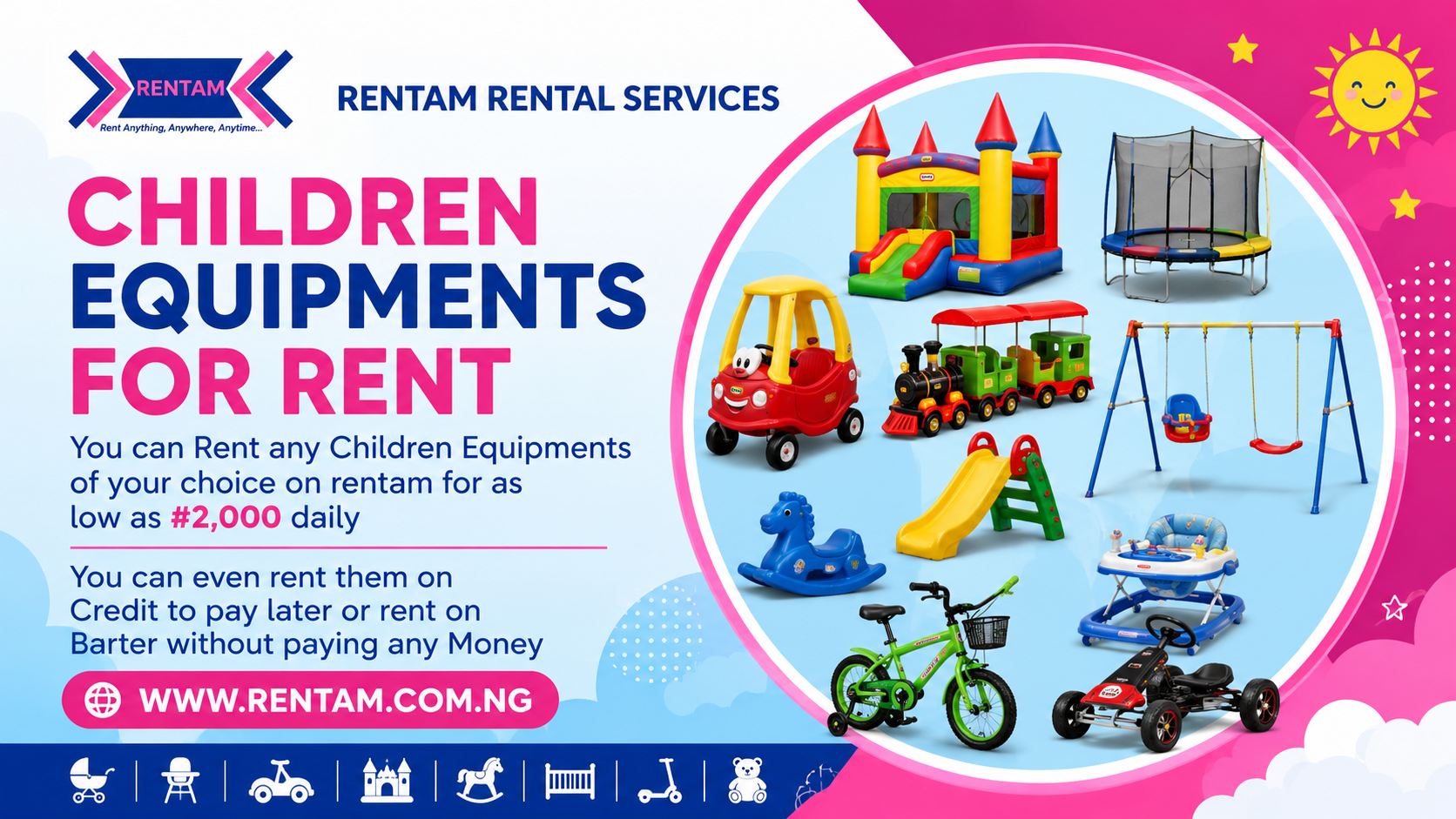
Few things bring more joy to a Nigerian children’s party than a bouncy castle, and few pieces of equipment are more obviously suited to occasional rather than permanent ownership. Trampolines, bouncy castles, and playground structures like slides and swing sets are large, expensive, and used intensively for specific occasions or seasonal periods rather than daily — exactly the kind of equipment that makes the strongest case for renting rather than buying.
Rentam lists bouncy castles in various sizes and themes for birthday parties and events, trampolines for home recreational use, and playground equipment including slides and swing sets for schools, daycare centres, and recreational facilities.
A family in Lagos planning their child’s birthday party can rent a bouncy castle for the event day, delight the young guests, and return the equipment the same evening rather than owning equipment used once a year. A daycare centre in Abuja setting up an outdoor play area can rent playground equipment for a trial period to gauge usage and durability needs before committing to permanent installation. Recreational equipment makes childhood memorable. Rentam makes it accessible for exactly the occasion or period it is needed.
Children’s Bicycles, Balance Bikes, Scooters, and Ride-On Cars
Children move through mobility toys at a pace few parents anticipate — a balance bike perfectly sized today is too small in eight months, a first bicycle with training wheels gives way to a proper bicycle within a year or two, and ride-on cars capture a toddler’s imagination for a matter of months before losing their appeal. Buying new equipment at every size transition adds up quickly, particularly for families with multiple children moving through these stages in sequence.
Rentam lists balance bikes for early mobility development, children’s bicycles in various sizes for different age groups, scooters for older children, and ride-on cars for toddlers.
A family in Enugu with a toddler moving from a ride-on car to a balance bike, and later to a first bicycle, can rent each item for the months it actually fits, avoiding a cycle of purchases for equipment that is outgrown almost as soon as it is mastered. A recreational centre offering children’s activity days can rent a fleet of scooters or balance bikes for a specific programme, rather than maintaining permanent inventory used only during scheduled sessions. Children’s mobility toys support real physical development. Rentam makes keeping pace with that development affordable.
Educational Equipment and Learning Aids
Beyond furniture and mobility, many families, schools, and childcare centres need specific educational equipment and learning aids — sensory play equipment, early learning tools, and developmental aids that support specific stages of a child’s cognitive growth. These items are often needed for a defined developmental window or a specific programme’s duration rather than as permanent household fixtures.
Rentam lists educational and learning aid equipment for early childhood development, sensory play equipment for developmental support, and specialized learning tools for specific educational programmes.
An NGO running an early childhood development programme in a rural community can rent a set of learning aids for the programme’s three-month duration, deliver quality developmental support to the children involved, and return the equipment once the intervention concludes. A daycare centre trialling a new curriculum approach can rent the specific equipment that approach requires before committing to permanent purchase, confirming the method’s effectiveness with real children first. Educational equipment supports a child’s growth at every stage. Rentam makes it accessible without unnecessary long-term investment.
Rental Duration Options for Children’s Equipment on Rentam
Children’s equipment needs are defined by developmental stages, specific events, and programme timelines far more than by fixed calendar periods, and Rentam’s rental duration structure reflects this. Daily and weekend rentals suit party and event equipment — bouncy castles, children’s tables and chairs for a single celebration. Weekly rentals apply to short-term needs such as equipment for a visiting relative’s grandchild or a temporary childcare arrangement. Monthly rentals suit equipment needed across a defined stage — a stroller during a specific age range, a breast pump during a return-to-work transition. Extended and stage-based rentals, often three to twelve months, apply to equipment tied to a full developmental phase — a cot through the first year, a high chair through the toddler feeding stage — with the option to transition smoothly to the next size as your child grows. Programme-based and seasonal rentals serve schools, NGOs, and institutions running defined interventions or terms.
We understand that a car seat is needed for exactly as long as your child fits it, not on a fixed twelve-month contract, and that a bouncy castle is needed for one Saturday, not a month. Rentam’s Children’s Equipment rental durations are built around your child’s actual stage and your actual occasion, not around administrative convenience.
How Children’s Equipment Listings Are Verified — Hygiene and Safety Inspections
Because this equipment is used by children, and often comes into direct contact with infants who cannot advocate for their own safety, Rentam holds the Children’s Equipment category to hygiene and safety standards beyond what we require in most other sections of our platform. Equipment owners listing items in this category are required to provide documentation confirming ownership, evidence of the item’s current condition, and confirmation that the equipment meets relevant safety standards — particularly for car seats, cots, and any item directly supporting a child’s physical safety.
Beyond condition verification, every listing in this category is subject to hygiene review. Items that come into close or direct contact with a child — cots, high chairs, bath tubs, feeding equipment — must be thoroughly cleaned and sanitized between rentals, and owners are required to confirm this cleaning process as part of our listing standards. Listings that misrepresent condition, safety compliance, or cleanliness are removed from the platform immediately, and owners found to have misrepresented these details are subject to account suspension. Verified listings are marked clearly, giving parents and institutions the confidence that what arrives at their door has been properly reviewed before it ever reaches a child.
Transparent Pricing and Flexible Payment Options
Every Children’s Equipment listing on Rentam states its rental rate clearly — daily, weekly, monthly, or stage-based — with all additional costs, including delivery, assembly where applicable, and refundable deposits, disclosed upfront. There are no surprise charges once a parent or institution has committed to a rental.
We also recognise that family budgets and institutional cash flow do not always align neatly with the moment equipment is needed — a new baby’s arrival often comes with unpredictable timing and cost. Our Rent Now, Pay Later option allows qualified renters to access essential equipment immediately with structured payment terms. Our Barter option, facilitated through the JummikPlus Barter Purchase Service, allows equipment access to be offset through assessed value in goods or services where cash is not immediately available. Our Union option allows schools, cooperatives, or groups of parents to pool resources for shared equipment needs — several families splitting the cost of equipment used on a rotating basis, for instance. And discount pricing applies to extended stage-based rentals and repeat institutional bookings.
Responsible Use, Cleanliness, and Child Safety Expectations
Children’s equipment carries responsibilities beyond what applies to most other rental categories, precisely because a child’s safety and wellbeing are directly at stake. Rentam expects equipment owners to deliver items in genuinely clean, sanitized, and safe condition, to disclose any known limitations clearly, and to confirm that safety-critical items like car seats and cots meet appropriate safety standards before listing.
For renters, we expect equipment to be used strictly as intended and according to any safety guidelines provided, that children are appropriately supervised while using rented equipment, that any damage or safety concern is reported immediately, and that equipment is returned clean and in the condition received, with normal use wear excepted. Given the direct contact many of these items have with children, we also expect renters to clean equipment reasonably before return, supporting the hygiene standard the next family or institution deserves. These expectations exist not to burden parents and caregivers, but because nothing in our marketplace matters more than the safety of the children this equipment ultimately serves.
Frequently Asked Questions (FAQ)
Q1. How do I know rented equipment is clean and safe for my baby?
Every listing in our Children’s Equipment category is subject to hygiene review, and owners are required to confirm proper cleaning and sanitization between rentals, particularly for items with direct child contact like cots, high chairs, and bath tubs. Verified listings are marked clearly, and we encourage renters to review photos and ask owners directly about cleaning practices before booking.
Q2. Can I rent equipment for just one event, like a birthday party?
Yes. Bouncy castles, children’s tables and chairs, and similar party equipment are commonly available for single-day or weekend rental, priced specifically for one-time event use.
Q3. What if my child outgrows the equipment before my rental period ends?
Contact Rentam or the equipment owner directly — many rentals can be adjusted or exchanged for the next appropriate size, particularly for stage-based rentals like cots, car seats, and strollers, subject to availability.
Q4. Does Rentam deliver and assemble equipment like cots and bunk beds?
This varies by listing. Many larger items include delivery and basic assembly as part of the rental; others require the renter to arrange collection or assembly separately. Each listing states these terms clearly upfront.
Q5. What happens if rented equipment is damaged while in my care?
If damage occurs during the rental period, the renter is generally responsible for repair or replacement cost, which is why many listings require a refundable security deposit. If a fault is pre-existing rather than caused by the renter, the owner is responsible, and Rentam’s dispute process is available to resolve any disagreement fairly.
Q6. Can schools and daycare centres set up ongoing rental arrangements rather than booking individually each term?
Yes. Institutions can arrange term-based or programme-based rentals directly with equipment owners through Rentam, and our Union option supports shared arrangements across cooperatives, schools, or groups of institutions with overlapping equipment needs.
Q7. Is children’s equipment available for rent outside Lagos and Abuja?
Our inventory spans cities and communities across Nigeria and continues to grow. Where listings are limited locally, contacting Rentam directly or visiting a JummikPlus Agent often allows us to source equipment through our wider partner network.
Conclusion — Equip Every Stage. Waste Nothing.
Children grow through their early years in a series of brief, precious windows — the newborn months, the crawling stage, the first steps, the first bicycle, the birthday parties that mark each passing year. Every one of those windows deserves the right equipment, properly clean and genuinely safe. None of them deserves the financial burden of a full purchase for something that will be outgrown, outlived, or used only once.
For too long, Nigerian parents and the institutions that serve children have faced an unfair choice — spend heavily on equipment with a shockingly short useful life, settle for uncertain secondhand alternatives with no guarantee of safety, or simply go without. Rentam Rental Services was built to end that trade-off. We believe a new mother in Lagos should be able to access a properly certified car seat with the same ease and confidence as a well-resourced daycare centre outfitting an entire nursery. We believe every item that touches a child should meet real hygiene and safety standards, regardless of whether it is bought or rented. And we believe flexible payment options — including Rent Now Pay Later, Barter, and Union arrangements — should meet families where their circumstances actually are, especially during the unpredictable, often costly early months of a child’s life.
Through the Children’s Equipment category on Rentam, that belief is now practical. Every listing on our platform is an opportunity — to give your newborn a safe place to sleep without a six-figure purchase, to make a birthday unforgettable for one afternoon rather than a permanent fixture in your yard, to furnish a growing school without guessing at future enrollment, and to meet your child exactly where they are, at every stage, without paying for equipment they will soon outgrow.
If you are ready to access the children’s equipment your family, school, health facility, or event needs — or ready to earn from equipment your own children have outgrown but that remains in excellent condition — visit rentam.com.ng today. Browse the Children’s Equipment category, find what this stage of your child’s life calls for, and take the first step toward parenting and caregiving without unnecessary waste.
Your child is growing fast. We have the equipment to keep up, one stage at a time.
Visit rentam.com.ng or call/chat on 08036830251 to get started.



 Technical Equipment Rentals on Rentam: Your Complete Guide to Renting Technical and Diagnostic Equipment in Nigeria
Leave a Reply