From Concrete Mixers to Scaffolding: Everything You Can Rent in Rentam’s Building Equipment Category
Building anything in Nigeria — whether a family home, a block of flats, a shop, a church, or even a simple boundary fence — requires equipment. Not just tools that fit in a toolbox, but the larger machinery and devices that make construction work faster, safer, and more professional. A bricklayer in Aba starting a three-storey residential project knows he needs scaffolding to work safely at height, but buying a complete scaffolding set for ₦400,000 when the project will last only two months makes no financial sense. A property developer in Lagos constructing four duplexes needs concrete mixers, vibrators, and block moulding machines, but purchasing all that equipment for ₦2,000,000 means less money available for materials, labour, and the profit margin the project is supposed to generate. A homeowner in Kaduna building his retirement house needs a ladder tall enough to reach the roof, a wheelbarrow for moving materials, and a water pump for the foundation work, but buying equipment he will use for six months and then store indefinitely feels wasteful.
The challenge is not limited to individual builders. Contractors face equipment needs that are project-specific and temporary. A building contractor in Port Harcourt wins a contract to construct a school — a six-month job requiring scaffolding, mixers, compactors, and cutting machines. Buying all that equipment means massive capital outlay before the first payment from the client arrives. When the project finishes, the equipment sits idle, depreciating in storage, waiting for the next contract that may be weeks or months away. A mason in Enugu builds boundary walls and small structures — projects that need a concrete mixer for a few days each, but buying a mixer for occasional use means the machine spends more time parked than working.
These are not stories of people who lack ambition or work ethic. They are stories of the gap between what Nigerian builders need to complete projects properly and efficiently — and what the traditional equipment ownership model can deliver without financial strain. Building equipment represents one of the largest cost burdens in construction, yet much of this equipment sits unused for significant portions of the year. A concrete mixer might run intensively for three weeks during foundation and slab work, then sit idle for months. Scaffolding is essential during wall construction and plastering but becomes a storage problem once the building reaches roof level. A block moulding machine produces thousands of blocks during the early phase of a project and has no purpose once block laying is complete.
The traditional model forces builders and contractors into an impossible choice: either buy all the equipment a project requires and watch capital disappear into machinery that will spend much of its life idle, or attempt to build without proper equipment, compromising on quality, safety, and efficiency. Neither option serves the contractor managing tight project budgets, the developer trying to maximize return on investment, or the individual builder constructing a home with limited savings.
What has been missing from the Nigerian building industry is a structured, reliable way to access building equipment temporarily — to rent mixers, scaffolding, compactors, and all necessary building machinery for exactly as long as a project phase requires, at a cost that reflects actual usage rather than permanent ownership burden, and with the confidence that equipment arrives in working condition, on time, and as described. Borrowing equipment from other contractors creates dependencies and limits project scheduling. Buying cheap, poorly made alternatives wastes money on machines that break mid-project, causing delays, rework, and ultimately higher total costs.
Rentam Rental Services was built to solve this problem. Through the Building Equipment category on our platform, we have created a structured marketplace where Nigerian builders, contractors, developers, and individual project owners can access the full range of building machinery and equipment they need to complete construction projects properly, safely, and efficiently, for exactly as long as each project phase requires, without the crushing burden of permanent ownership cost.
This guide walks you through everything available in Rentam’s Building Equipment category. We explain what building equipment is, describe each major equipment type available on the platform, clarify who each type serves, and show you how to rent with confidence and clarity. Whether you are a professional contractor, a property developer, or someone building your own house, this guide is written for you.
What Is Building Equipment?
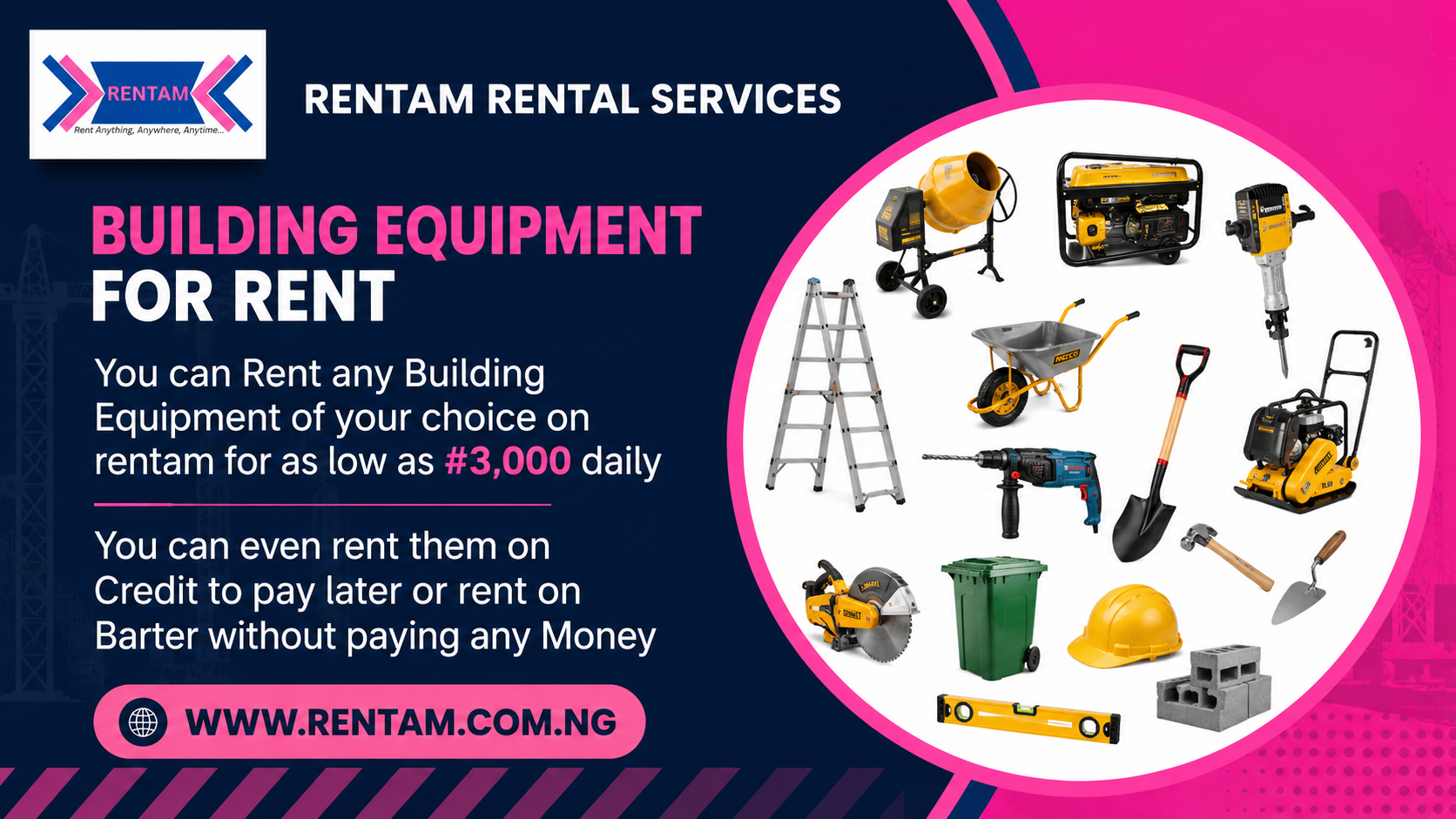
Building equipment refers to the machinery, devices, and mechanical implements used specifically in the construction and structural development of buildings — the equipment that mixes concrete, moves materials, provides height access, compacts soil, moulds blocks, and performs the mechanical tasks that transform raw materials into completed structures. In everyday Nigerian building contexts, this is the equipment you see on active construction sites — the concrete mixers turning cement and aggregate into usable concrete, the scaffolding providing safe working platforms at height, the ladders allowing workers to reach elevated areas, the block moulding machines producing sandcrete blocks, the vibrators consolidating freshly poured concrete, the wheelbarrows moving materials across sites, the compactors preparing foundation bases, the water pumps supplying or removing water, and the cutting machines shaping materials to required dimensions.
Building equipment ranges from simple manual devices like wheelbarrows and hand-operated block moulders that require human effort to operate, to powered machinery like electric concrete mixers and motorized compactors that require fuel or electricity. Both ends of this spectrum, and everything in between, fall under Rentam’s Building Equipment category. The defining characteristic is building-specific function: if a machine or device is used directly in the process of constructing, finishing, or completing a building structure, it belongs in this category.
Building equipment is not only for large construction companies or major property developers. A homeowner in Ibadan building a two-bedroom bungalow needs a concrete mixer for foundation and floor work. A bricklayer in Onitsha constructing a perimeter fence needs scaffolding for sections above shoulder height. A small contractor in Warri building a shop needs a block moulding machine to produce blocks on-site rather than buying them pre-made. A church in Enugu constructing a new hall needs wheelbarrows for moving materials and a water pump for the foundation excavation. All of these users, and the full breadth of their equipment needs, are what Rentam’s Building Equipment category was built to serve.
What Is the Building Equipment Category on Rentam?
Rentam organises its listings into focused categories so that users can navigate directly to what they need without confusion. The Building Equipment category is one of our core practical sections, housing a comprehensive inventory of building-specific machinery and devices available for rent across Nigeria.
Think of Rentam’s Building Equipment section as a structured equipment depot — one that exists on your phone or computer, is accessible from anywhere in Nigeria, and connects you only to verified, documented rental arrangements. Unlike calling someone you heard about who “has a mixer somewhere,” or buying equipment you will use for one project and then struggle to store or resell, renting through Rentam means you know exactly what you are getting, what it costs, how long you can have it, and what happens if something does not work as expected.
The category covers concrete mixers for preparing concrete on-site, scaffolding and access equipment for safe work at height, ladders for reaching elevated areas, block moulding machines for producing building blocks, concrete vibrators for consolidating poured concrete, material handling equipment including wheelbarrows and hoists, soil compactors for foundation preparation, water pumps for supply and dewatering, cutting and shaping machines for materials preparation, and more. Each of these has its own listing standards, rental duration structures, and relevant user groups — and we will walk through them all in this guide.
Concrete Mixers — The Heart of Every Building Project
Concrete is the foundation of almost every building in Nigeria — literally and figuratively. Foundations, floor slabs, lintels, columns, and many other structural elements require concrete, and producing concrete on-site requires a mixer. Concrete mixers range from small portable drum mixers suitable for residential projects to large diesel-powered mixers for commercial construction. A quality concrete mixer costs between ₦80,000 and ₦350,000 depending on capacity and power source, yet the mixer is used intensively only during specific project phases — foundation work, floor casting, and column pouring — and sits idle during block laying, roofing, and finishing phases.
For a contractor building a house, buying a mixer for the foundation and slab work means the machine will be used for perhaps three or four weeks out of a six-month project. For a homeowner building his own house over a year, the mixer might run for a total of one month while the building takes twelve months to complete. Rentam addresses this inefficiency through concrete mixer listings.
On Rentam, concrete mixers available for rental include portable electric drum mixers suitable for small residential projects with access to power supply, diesel-powered mixers for sites without reliable electricity or for larger volume mixing, hand-operated mixers for very small jobs or remote locations, and large-capacity mixers for commercial projects requiring high concrete output.
A contractor in Asaba building a duplex can rent an electric concrete mixer for the four-week foundation and ground floor slab phase, mix all required concrete efficiently, and return the mixer when concrete work is complete rather than buying a machine that will sit unused during the remaining four months of block laying, roofing, and finishing. A homeowner in Jos building a bungalow can rent a diesel mixer for the foundation and floor work phases, produce quality concrete on-site at lower cost than buying pre-mixed concrete, and return the mixer when concreting is done. A small contractor in Calabar can rent mixers for specific projects, operate professionally, and avoid tying up capital in equipment that depreciates while waiting for the next contract. Concrete mixers enable quality building. Rentam makes them accessible.
Scaffolding and Access Equipment — Building Safely at Height
Building upward requires working at height, and working at height safely requires proper access equipment. Scaffolding provides stable working platforms for block laying, plastering, painting, and all elevated work on building exteriors and interiors. In Nigeria, bamboo poles and improvised platforms are still common on building sites, but they represent serious safety risks. Proper steel scaffolding — the kind with frames, platforms, and guardrails — costs between ₦300,000 and ₦1,500,000 for a complete set depending on building height and coverage area.
For a contractor building a two-storey house, buying scaffolding for the eight-week period of elevated work means the equipment becomes a storage burden and capital waste once the building is roofed. For a homeowner building a bungalow, scaffolding might be needed for only two weeks of wall plastering and one week of painting. Rentam makes proper scaffolding accessible through rental.
Scaffolding on Rentam includes steel tube and coupler scaffolding for flexible configuration on various building shapes, frame scaffolding for faster setup and dismantling on standard rectangular buildings, mobile scaffolding towers for interior work and smaller exterior jobs, and scaffolding accessories including platforms, guardrails, and base plates for complete safe working systems.
A building contractor in Lagos constructing a three-storey residential building can rent scaffolding for the ten-week period of elevated block laying and plastering work, provide safe working conditions for his masons and labourers, and return the scaffolding when exterior work is complete rather than buying equipment that will sit in storage between projects. A homeowner in Kano plastering and painting his completed house can rent mobile scaffolding for the three-week finishing period, work safely at ceiling height, and return the scaffolding when the house is finished. A church in Warri constructing a tall hall can rent scaffolding for the construction period, build safely and professionally, and return the equipment when the building is complete. Scaffolding enables safe elevated work. Rentam makes it accessible without permanent investment.
Ladders — Simple Access for Essential Tasks
Not every elevated task requires full scaffolding. Installing roof sheets, fixing windows, painting small areas, cleaning gutters, and many other building tasks need only ladder access. Extension ladders, step ladders, and multi-position ladders provide height access for specific tasks without the setup complexity of scaffolding. Quality ladders cost between ₦25,000 and ₦120,000 depending on height and type, and while ladders are more affordable than scaffolding, buying them for occasional use still represents unnecessary expense for many builders.
A homeowner completing finishing work on his house needs a ladder for a few specific tasks — mounting ceiling fans, installing curtain rods, painting high walls — but does not need to own a ladder permanently. A contractor needs different ladder heights for different projects and different tasks. Rentam lists ladders for rental.
Ladders on Rentam include extension ladders in various heights for outdoor work reaching up to second-storey levels, aluminium step ladders for indoor work and general elevated access, multi-position ladders that convert between step ladder and extension configurations for versatile use, and platform ladders with work platforms for tasks requiring tools and materials at height.
A homeowner in Ibadan installing ceiling fans and light fixtures throughout his new house can rent an extension ladder for the installation weekend, complete all elevated work safely, and return the ladder on Monday rather than buying equipment used for one weekend and then stored indefinitely. A painter in Enugu working on interior painting contracts can rent ladders as needed for each job, use the right ladder height for each space, and avoid storing multiple ladder sizes between jobs. A maintenance worker in Abuja can rent ladders for specific building maintenance tasks, access elevated areas safely, and return equipment when maintenance is complete. Ladders provide essential height access. Rentam makes them accessible.
Block Moulding Machines — Producing Building Blocks On-Site
Sandcrete blocks — the rectangular building blocks used for walls throughout Nigeria — are essential for almost every building project. Blocks can be purchased pre-made from block makers, or they can be produced on-site using block moulding machines. Producing blocks on-site typically reduces block costs significantly compared to buying pre-made blocks, but block moulding machines cost between ₦150,000 and ₦600,000 depending on whether they are manual, semi-automatic, or fully hydraulic.
For a homeowner building a house, buying a block moulding machine to produce the required blocks means owning expensive equipment that has no use once block production is complete. For a contractor who builds various projects, owning block moulding machines ties up capital in equipment used only during early project phases. Rentam makes block production accessible through machine rental.
Block moulding machines on Rentam include manual machines suitable for small projects with labor available for operation, semi-automatic machines for medium-scale projects requiring higher daily output, and hydraulic machines for large projects needing high-volume block production with minimal manual labor.
A homeowner in Owerri building a three-bedroom house can rent a semi-automatic block moulding machine for the three-week block production period, produce all required blocks on-site at lower total cost than buying pre-made blocks, and return the machine when enough blocks are stockpiled rather than owning equipment with no further use. A small contractor in Benin City can rent block moulding machines for specific projects, produce blocks efficiently, and return machines between contracts rather than maintaining equipment that sits idle. A community development project in a rural area can rent a manual block moulder for a school construction project, produce blocks locally with community labor, and return the machine when the project is complete. Block moulding machines enable on-site block production. Rentam makes them accessible.
Concrete Vibrators — Consolidating Concrete for Structural Strength
Concrete vibrators are mechanical devices inserted into freshly poured concrete to remove air bubbles and ensure the concrete settles uniformly around reinforcement bars. Proper vibration is essential for structural concrete strength and durability, yet concrete vibrators are used only during concrete pouring — a task that occupies perhaps three or four days out of a months-long building project. Concrete vibrators cost between ₦40,000 and ₦150,000 depending on type and power, and buying them for occasional use represents poor capital allocation.
Many Nigerian building failures have their roots in poorly consolidated concrete — concrete that was not properly vibrated during pouring, leaving voids and weak spots that compromise structural integrity. The cost of renting a vibrator is minimal compared to the structural consequences of weak concrete. Rentam lists concrete vibrators for rental.
Concrete vibrators on Rentam include poker vibrators (immersion vibrators) that are inserted directly into wet concrete — the most common type for Nigerian construction, external form vibrators that attach to formwork for certain applications, and petrol-powered vibrators for sites without electricity supply.
A building contractor in Lagos casting a foundation slab can rent a concrete vibrator for the pour day, consolidate the concrete properly throughout the slab, and return the vibrator the next day rather than buying equipment used only during concrete pours. A homeowner in Kaduna casting floor slabs can rent a vibrator for each concrete pour day, ensure structural quality, and pay only for the days the equipment is actually needed. A contractor in Warri can rent vibrators for foundation, column, and slab pours across a project, maintain structural standards, and return equipment between concrete work phases. Concrete vibrators ensure structural strength. Rentam makes them accessible.
Material Handling Equipment — Moving Materials Across Sites
Building sites require constant movement of materials — sand, cement, gravel, blocks, water, mixed concrete, and waste all need to be transported from storage areas to work points. Wheelbarrows are the most common material handling equipment on Nigerian building sites, used by virtually every project regardless of size. While wheelbarrows are relatively affordable (₦15,000 to ₦40,000 each), projects often need multiple wheelbarrows simultaneously, and buying six or eight wheelbarrows for a project means owning equipment with limited use once the project ends.
Beyond wheelbarrows, some projects need hoists for lifting materials to upper floors, material lifts for efficient vertical transport, or site buggies for moving heavy loads. Rentam lists material handling equipment for rental.
Material handling equipment on Rentam includes standard construction wheelbarrows for general site material movement, heavy-duty wheelbarrows for concrete and aggregate transport, manual hoists for lifting materials to upper levels on multi-storey buildings, and material carts for moving blocks and bagged materials.
A contractor in Onitsha building a two-storey house can rent six wheelbarrows for the duration of the project, ensure efficient material movement throughout construction, and return the wheelbarrows when the building is complete rather than owning equipment that will sit unused between projects. A homeowner in Abeokuta can rent wheelbarrows for the active construction period, move materials efficiently across the building site, and return equipment when construction work ends. A building contractor in Port Harcourt constructing a three-storey building can rent a manual hoist for lifting blocks and materials to upper floors, improve site efficiency and worker safety, and return the hoist when the building reaches roof level. Material handling equipment enables efficient site operations. Rentam makes it accessible.
Soil Compactors — Preparing Foundations That Last
Before a building foundation is poured, the soil beneath must be properly compacted to improve load-bearing capacity and prevent settlement that causes foundation cracks and structural problems. Soil compaction requires mechanical compactors — plate compactors or jumping jacks for smaller areas and trenches, or larger vibratory rollers for extensive foundation areas. Compaction equipment costs between ₦80,000 and ₦400,000 depending on type and size, and this equipment is used only during the foundation preparation phase — perhaps one or two weeks at the beginning of a project.
Proper foundation preparation prevents problems that appear months or years later — settled floors, cracked walls, and structural distress. The cost of renting compaction equipment for foundation work is minimal compared to the cost of foundation repairs or building failures. Rentam lists soil compactors for rental.
Soil compactors on Rentam include plate compactors for foundation trenches and smaller compaction areas, jumping jack compactors for trench work and confined spaces, and vibratory rollers for larger foundation areas on commercial projects.
A contractor in Abuja building a residential house can rent a plate compactor for the foundation preparation week, compact the foundation base properly before pouring, and return the compactor when foundation work is complete rather than buying equipment used only at project start. A homeowner in Enugu can rent a compactor for foundation preparation on his building project, ensure proper soil bearing capacity, and avoid future settlement problems at minimal rental cost. A property developer in Lagos constructing multiple houses can rent compactors for the foundation phase of each project, maintain quality standards across developments, and return equipment between project phases. Soil compactors prepare lasting foundations. Rentam makes them accessible.
Water Pumps — Managing Water On Building Sites
Building sites encounter water in two main ways: the need for water supply for mixing concrete, curing work, and general site use, and the problem of unwanted water — groundwater in foundation trenches, rainwater accumulation, or flooding that stops work. Both situations require pumps. Water pumps cost between ₦30,000 and ₦200,000 depending on capacity and type, and while pumps are essential during certain project phases, they sit unused during dry work phases like block laying, roofing, and finishing.
A building site in an area with high groundwater needs dewatering pumps during foundation excavation but has no use for pumps once the foundation is above ground level. A site without municipal water supply needs pumps to fill storage tanks during the concrete work phase but not during block laying. Rentam lists water pumps for rental.
Water pumps on Rentam include surface pumps for drawing water from wells or tanks for site use, submersible pumps for dewatering flooded foundation trenches and excavations, and high-capacity centrifugal pumps for large-volume water movement on bigger projects.
A contractor in Warri whose foundation trench fills with groundwater can rent a submersible pump for the excavation and foundation phase, keep the site dry and workable, and return the pump when the foundation is above ground level rather than buying equipment that becomes redundant once foundation work is complete. A homeowner in Kano can rent a surface pump to fill water storage for concrete mixing during the foundation and slab work period, ensure consistent water supply for quality concrete, and return the pump when concrete work is finished. A property developer in Calabar can rent pumps for the wet-work phases of multiple building projects, manage water needs efficiently, and return equipment during dry construction phases. Water pumps manage site water needs. Rentam makes them accessible.
Cutting and Shaping Machines — Preparing Materials to Size
Building projects require cutting and shaping materials to specific dimensions — cutting steel reinforcement bars to length, cutting tiles and blocks to fit corners and edges, cutting wood for formwork and roofing, and cutting pipes for plumbing installation. Cutting machines including angle grinders, tile cutters, steel cutters, and circular saws perform these tasks efficiently, yet each machine costs between ₦20,000 and ₦150,000, and buying every cutting tool a project might need represents significant equipment investment.
A project uses tile cutters only during the floor and wall tiling phase — perhaps one or two weeks of a months-long project. Steel cutting equipment is needed when preparing reinforcement but not during other phases. Rentam lists cutting and shaping machines for rental.
Cutting machines on Rentam include angle grinders for cutting steel, stone, and tiles, tile cutters — manual and electric — for ceramic and porcelain tile cutting, steel bar cutters for cutting reinforcement bars to length, and circular saws for cutting wood for formwork and roofing.
A contractor in Ibadan installing floor tiles in a house can rent an electric tile cutter for the tiling week, cut all tiles precisely and efficiently, and return the cutter when tiling is complete rather than buying equipment used only during finish work. A building contractor in Asaba can rent steel cutting equipment during the foundation and column work phases when reinforcement is being prepared, complete all steel preparation efficiently, and return equipment during phases not requiring steel cutting. A homeowner in Jos can rent cutting tools as needed for specific tasks during his building project, use the right tool for each material, and avoid buying multiple cutting machines. Cutting machines prepare materials precisely. Rentam makes them accessible.
Rental Duration Options for Building Equipment on Rentam
One of the features that makes Rentam’s Building Equipment category particularly practical for Nigerian builders is the flexibility of rental duration. Building equipment needs are project-phase specific — some equipment is needed for days, others for weeks, others for months depending on project scale and phase. Rentam’s rental duration structure reflects this reality.
Building equipment on Rentam is available under the following duration structures, depending on the specific listing and equipment type. Daily rentals are available for equipment needed for short, specific tasks — a concrete vibrator for a pour day, a tile cutter for a few days of tiling, a pump for a day of dewatering. Weekly rentals apply to equipment needed for short project phases — scaffolding for a week of exterior plastering, a mixer for a week of foundation work, compactors for foundation preparation. Monthly rentals are available for equipment used across extended project periods — scaffolding for multi-storey construction, mixers for projects with multiple concrete pours, wheelbarrows throughout active construction. Project-based rentals are available for equipment needed from a specific project start point to completion point, with duration tied to actual project timeline rather than fixed calendar periods.
We believe that rental duration should match actual project phase timelines, not force builders into rental periods that create waste or unnecessary cost. That principle guides how we structure every listing in our Building Equipment category.
How Building Equipment Listings Are Verified on Rentam
Renting building equipment informally in Nigeria carries risks every builder knows. The mixer arrives but the drum does not turn smoothly. The scaffolding has bent frames or missing components. The ladder has a cracked rung that was not mentioned. The vibrator motor is weak and ineffective. These experiences cause project delays, safety hazards, and ultimately cost more than the rental savings were worth.
Rentam’s verification process for Building Equipment listings addresses these risks directly. Equipment owners who list on our platform are required to provide documentation confirming ownership, evidence of the equipment’s current working condition including photos showing actual state and any wear or damage, and for safety-critical equipment like scaffolding and ladders, confirmation of structural integrity and safe working condition. Listings that misrepresent equipment condition are removed from the platform, and owners who engage in repeated misrepresentation are subject to account suspension.
Verified listings are marked clearly on the platform, giving renters reliable signals about which equipment has been reviewed. While we continue to strengthen our verification infrastructure as our inventory grows, the principle guiding our approach is consistent: every builder should be able to trust what they are renting before committing money or project timelines to it.
Transparent Pricing for Building Equipment Rentals
Pricing in Nigeria’s informal equipment rental market is notoriously inconsistent. The rate quoted over the phone changes when the equipment is delivered. Hidden charges for transport or accessories appear without warning. Deposit requirements are unclear. This unpredictability makes project budgeting impossible and creates power imbalances that disadvantage renters.
Rentam’s approach to building equipment pricing is fundamentally different. Every listing on our platform is required to state the rental rate clearly — whether daily, weekly, or monthly — and to disclose all additional costs upfront. Delivery charges where applicable, fuel or power requirements, and refundable deposit amounts must all be declared in the listing before the renter makes any commitment. No surprises. No hidden costs. No price changes after agreement.
This pricing transparency serves two purposes. It allows builders to budget accurately, knowing before they commit exactly what the total equipment cost will be for the project phase. And it creates a fair marketplace where equipment owners who offer honest, clear pricing attract more rentals than those who attempt to obscure costs. Fair pricing is not just an ethical commitment on Rentam — it is a structural requirement of how our marketplace operates.
Responsible Use of Rented Building Equipment
Building equipment is valuable, subject to hard use on construction sites, and sometimes dangerous if misused. Renting equipment through Rentam comes with responsibilities that apply to both equipment owners and renters, and we are explicit about these expectations.
Equipment owners listing on Rentam are expected to ensure that equipment is in safe working condition at delivery, that all necessary components and accessories are included, that any known operational quirks or limitations are disclosed, and that basic operating or safety instructions are provided where relevant. For renters, we expect that equipment is used for its intended building purposes, that reasonable care is taken to prevent damage and theft, that any malfunction or damage is reported immediately, and that equipment is returned at the agreed time in the condition received, normal construction use wear excepted.
Building sites are demanding environments. We understand this. The goal is not to hold renters to impossible standards of equipment preservation — it is to ensure that both sides act in good faith and with reasonable care. When that happens, equipment lasts longer, rental costs stay fair, and the marketplace works for everyone.
How to Search and Rent Building Equipment on Rentam
Using Rentam to find and rent building equipment is designed to be straightforward. Here is how the process works.
You visit rentam.com.ng and navigate to the Building Equipment category. You can search for specific equipment — “concrete mixer,” “scaffolding,” “block moulder,” “ladder” — or browse the category listings and apply filters for equipment type, location, rental duration, and price range. Once you find a listing that matches your project needs, you review the full details — equipment description, condition, specifications, rental rate, available duration options, and delivery or collection terms.
If the listing supports direct booking, you proceed through Rentam’s secure booking process, agree to the rental terms, and complete payment through the platform. For listings requiring discussion before finalizing terms — common for large equipment or custom rental periods — we facilitate structured communication so all terms are documented before payment.
After rental confirmation, you receive documentation of the agreed terms. Rentam retains a transaction record for dispute resolution if needed. The equipment is then delivered to your site or made available for collection as agreed. From search to return, our process replaces the informality and risk of traditional equipment markets with something documented, fair, and reliable.
Frequently Asked Questions (FAQ)
Q1. Can I rent building equipment for just a few days or a single project phase?
Yes. Many building equipment listings on Rentam are available for daily or weekly rental, particularly for equipment needed for short project phases — a concrete vibrator for pour days, a tile cutter for a few days of tiling work, a pump for dewatering during foundation excavation. Each listing clearly states the shortest available rental period.
Q2. What happens if rented equipment breaks down during my project?
If equipment breaks down during the rental period due to a pre-existing mechanical issue rather than misuse, the equipment owner is responsible for repair or replacement within a reasonable timeframe. Rentam’s dispute resolution process is available if the owner does not respond appropriately. This is why we recommend completing all rentals through the platform’s documented system — so that breakdown liability is clear and enforceable.
Q3. Who is responsible for delivering equipment to my building site?
Delivery arrangements depend on the specific listing. Some equipment owners include delivery in the rental price, others charge separately for delivery, and some listings require the renter to arrange collection. Each listing clearly states delivery terms and costs where applicable. For large or heavy equipment like scaffolding and mixers, delivery is typically included or available for an additional fee.
Q4. Can I extend my rental period if my project takes longer than expected?
Yes. If your project phase requires more time than your original rental period covered, you can request an extension through Rentam, subject to the equipment’s availability. We recommend requesting extensions before the original period ends to give the equipment owner sufficient notice and ensure continuity for your project.
Q5. I own building equipment that sits idle between projects. Can I list it on Rentam?
Absolutely, and we actively encourage it. Idle building equipment is a cost — it depreciates, requires maintenance, and generates no return when not working. By listing your equipment on Rentam, you make it available to builders who need exactly what you own, and you earn rental income during periods it would otherwise sit unused. The listing process is straightforward, and Rentam provides the documentation and dispute support that makes renting out equipment safer than informal arrangements.
Q6. Is building equipment available for rent outside Lagos and Abuja?
Our inventory is distributed across Nigerian cities and states, and we continue to expand as more equipment owners join. If listings are limited in your location, contact Rentam directly — through the website, by calling or chatting on 08036830251, or by visiting a JummikPlus Agent near you. Our sourcing process means we can often locate equipment through our partner network even when not immediately visible in listings.
Q7. What if I need multiple pieces of equipment for the same building project?
Rentam supports multi-equipment rentals — you can search and rent different equipment types for different project phases, all documented through the platform. Many equipment owners offer package deals for common equipment combinations, and we can help coordinate multiple equipment needs for complete project support if you contact us directly.
Conclusion — Build Better. Spend Smarter.
Building in Nigeria — whether a family home, a rental property, a commercial structure, or a community facility — should not require choosing between doing the job properly and managing finances responsibly. A contractor should be able to use scaffolding for safe elevated work without tying up capital in equipment that sits unused between projects. A homeowner should be able to produce concrete with a quality mixer without buying machinery that has no use once the building is complete. A developer should be able to equip multiple building projects without equipment ownership costs that consume profit margins.
The traditional answer to building equipment needs in Nigeria has been either to buy everything and watch capital disappear into depreciating machinery, or to build without proper equipment and accept compromised quality, safety, and efficiency. Neither of these is a good answer. Neither serves the builder trying to complete projects professionally, the contractor managing project budgets carefully, or the homeowner building with limited resources.
Rentam Rental Services was built to provide a different path. We believe that access to building equipment should be structured, transparent, and flexible. We believe that a small contractor in Warri should be able to rent a concrete mixer with the same clarity and protection as a large developer in Lagos. We believe that builders should be able to plan equipment costs accurately and use the right equipment for each project phase without permanent ownership burden.
Through the Building Equipment category on Rentam, we are making that belief practical. Every listing on our platform is an opportunity — an opportunity to build properly without capital waste, to work safely without equipment ownership, to complete projects efficiently without machinery sitting idle, and to build your house, your business, or your project with the equipment it deserves.
If you are ready to access the building equipment you need — or ready to earn from equipment you own but use only occasionally — visit rentam.com.ng today. Browse the Building Equipment category, find what your project needs, and take the first step toward building smarter.
You have a project to build. We have the equipment to build it properly.
Visit rentam.com.ng or call/chat on 08036830251 to get started.
Rentam Rental Services — Rent Anything. Anytime. Anywhere.
Related posts:
Heavy Duty Equipment Rentals on Rentam: Your Complete Guide to Renting Heavy Machinery in Nigeria
How to Rent Transportation Equipment in Ekiti State Even If You Have No Money Through Rentam Rental ...
Trade Equipment Rentals on Rentam: Your Complete Guide to Renting Skilled Trade Equipment in Nigeria
Recent Rentals:


KnowledgeBase
- Benefits of Renting with Rentam: Equipments & Properties Rental in Nigeria Made Easy
- Business Equipment Rentals on Rentam: Your Complete Guide to Renting Business Equipment in Nigeria
- How to Rent Out Transportation Equipment in Jigawa State Whether You Own the Equipment or Not Through Rentam Rental Services
- How To Rent Transportation Equipment in Jigawa State Even If You Have No Money Through Rentam
 Technical Equipment Rentals on Rentam: Your Complete Guide to Renting Technical and Diagnostic Equipment in Nigeria
Leave a Reply